Thursday, September 4, 2014

The Silencing of Hans Schmidt

From January 1996 Issue of Free Speech: 

 The Silencing of Hans Schmidt

Hans Schmidt Was Thrown into Jail Simply for
Displeasing the Wrong People

By Dr. William Pierce

Perhaps you've noticed recently how pleased the news media have been to inform us that Mr. Clinton's popularity with the electorate is rising. His so-called "approval rating" is higher than it's ever been, largely because he is perceived as taking a decisive and principled stand to bring peace to Bosnia.

It's not that the American people are happy about the possibility of becoming involved in yet another war, but they are pleased to see their draft-dodging, pot- smoking President, who was in the streets with the Reds and the hippies chanting "Ho, ho, ho Chi Minh, the Viet Cong's gonna win" back during the Vietnam war, finally trying to act like a statesman by using American diplomacy and military power to end the butchery in Bosnia: finally trying to walk tall and carry a big stick. Probably that makes many Americans feel a little safer, feel that their President will stick up for them when they need him.

Well, let me tell you something else about Mr. Clinton's supposed principles: about the way he walks tall and sticks up for Americans when they need the support of their government. Five months ago, in August 1995, an American was seized by the German secret police at the airport in Frankfurt as he was preparing to return to the United States after visiting his 93-year-old mother in Germany. He was thrown into a German prison, where he remained until very recently, without trial and without bond. His name is Hans Schmidt. He lives in Pensacola, Florida. He has been a U.S. citizen for 40 years. He committed no crime while he was in Germany. He has never done anything, either in Germany or the United States, which is a crime under U.S. law.

Jailed in Democratic Germany: The Ordeal of an American Writer 
by Hans Schmidt, published by Guderian Books (December 1997)

What he had done, however, was publish a newsletter in 1994 in the United States which displeased the Jews. You see, Mr. Schmidt heads the German- American National Political Action Committee, an organization dedicated to the interests of Americans of German descent, like Mr. Schmidt himself - and like 55 million other Americans. One topic which Mr. Schmidt often discusses in his newsletters is the Jews' hate-propaganda campaign against Germany, especially their claim that the Germans gassed 6,000,000 of them to death during the Second World War, and therefore the Germans of today owe the Jews of today a free living. In particular, Mr. Schmidt criticized the anti-German hate film Schindler's List, pointing out a number of Jewish propaganda lies in the film.

Now, in the United States it's still not illegal to criticize a film - even a Jewish propaganda film. But in Germany it's a different story. In Germany to contradict the Jewish party line about the so-called "Holocaust" is illegal. It's what the Jews and their news media call a "hate crime." Many Germans are in prison today simply because they have written or said something the Jews didn't like.

That's because the German government today is a continuation of the occupation government imposed on the German people 50 years ago by the communist and democratic Allies who conquered Germany in the Second World War. It is a government in which German patriots were forbidden to participate. It consists of traitors who were willing to serve the conquerors of their people - of ambitious traitors who understood that the way to power and privilege in conquered Germany lay in pleasing the Jews. And these traitors were happy to impose on their own people whatever laws the Jews demanded. They taxed the German people so that the German government could send tens of billions of dollars to Israel in so-called "war reparations" - even though Israel didn't even exist during the war. And they enacted laws making it illegal for Germans to criticize or contradict Jews.

Now, of course, German laws are the business of the Germans. Until the German people rise up, hang their traitors, and form a patriotic government, they'll have to do without freedom of speech and freedom of the press. They'll have to obey the laws imposed on them by a government of traitors or pay the penalty for breaking those laws. But those laws cannot be imposed on Americans for what Americans do on American soil. The German government cannot. take away an American's right to say or write what he wants in America.

Hans Schmidt has been a naturalized American citizen for 40 years. He has committed no crime in Germany. The German government has no jurisdiction over what he has written in America. And yet he has been arrested by the German secret police and imprisoned. How can that be? Why did that happen?

I'll tell you. Hans Schmidt was arrested for two reasons. First, there are Jewish hate organizations in every country, including the United States and Germany, which not only make Jewish hate propaganda for the Jew-controlled media, but which also spy on the people of the country in which they are located. They compile hate lists of people who say or write things which displease them. They distribute these hate lists to their news media, and then the people on the lists are accused of "hate crimes" by the media. And they distribute these hate lists to the governments over which they have influence, and they demand that the governments take repressive action against the people on the lists. Hans Schmidt's name is high on most of these Jewish hate lists. That's one of the reasons he was arrested by the German secret police.

A second reason is that the German secret police knew ahead of time that the United States government would not protest Hans Schmidt's arrest. More important, they knew that the Jew-controlled news media would remain silent-that there would be no headlines in the New York Times or the Washington Post or the Wall Street Journal or any other Jewish newspaper.

They knew that the U.S. government would not protest, because the head of the secret police in the United States, Mr. Clinton's FBI Director Louis Freeh, has pledged to them repeatedly during the past two years that he would do everything he could to help them silence Americans who are saying things the Jews don't like. He has publicly lamented the fact that the United States does not have repressive laws like those in Germany, which prohibit Politically Incorrect speech. He has publicly lamented the fact that the FBI cannot arrest people like Hans Schmidt - and me and many other Americans on the Jews' hate lists - but he has pledged that he would help the German secret police arrest them.

And that's exactly what he has done. Mr. Freeh is a politically ambitious little man, and he knows which side his bread is buttered on. He knows whom he must please in order to remain in favor in the Clinton government. And so when Americans on a Jewish hate list travel to another country, Mr. Freeh's secret police in Washington tip off the secret police in the other country. They collaborate in punishing American citizens for exercising their Constitutional rights.

And of course, it's not just Mr. Freeh who is engaged in this subversive, anti- American activity. The whole Clinton government is composed of people who want to abolish the U.S. Constitution and its Bill of Rights, so that they can usher in the New World Order, where no one will be permitted to say or write anything which is not Politically Correct. They want a New World Order governed by "hate laws," where anyone who doesn't toe the line can be thrown into prison for a "hate crime." They take their lead from Jews who already have succeeded in imposing such laws on the people of Germany, of Canada, of Britain, and of many other European countries. The Clinton government could not silence Hans Schmidt while he was in America, but they did collaborate with the German government in silencing him, and they continue to collaborate with the German government by failing to protest its imprisonment of an American citizen.

Contrast this despicable, treasonous behavior of the Clinton government in Hans Schmidt's case with its behavior in the case of the Chinese dissident, Harry Wu. We've all heard about Harry Wu, because the controlled news media in America made a celebrity of him when he was arrested by the Chinese government a few months ago. The Clintonistas became his champions and protectors. Mrs. Clinton wouldn't attend an international feminist conference in China, because the Chinese had Harry Wu in jail. And Harry Wu had quite clearly broken Chinese law in China by illegally sneaking into the country with a forged passport. We may sympathize with Mr. Wu's anti-Communism, but we cannot honestly pretend to be outraged when the Chinese government arrests him for entering China with a forged passport. That's illegal everywhere.
 
Hans Schmidt, on the other hand, did nothing illegal in either Germany or the United States. He was arrested solely because the Jews demanded it, and because their lackeys in the German government knew that their lackeys in the U.S. government wouldn't protest. That is something to be outraged about.

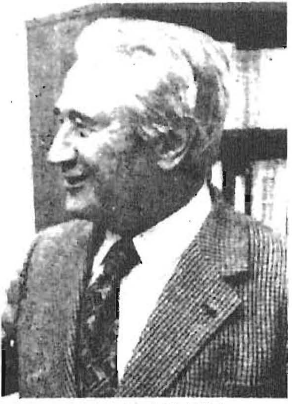
Hans Schmidt with Dr. Pierce, among friends

Now, I've known Hans Schmidt for 15 years. He's a personal friend. At a time when I was even poorer than I am today, he gave me an automobile. It's an automobile which my wife still drives. I've spoken often with him over the years and shared important information with him. So I have a personal reason for being outraged at what has been done to Hans Schmidt. But you should be just as outraged as I am. The attack on Hans Schmidt's rights and freedom is an attack on the rights and freedom of every American. If Hans Schmidt can be silenced, so can I - or you - or anyone. If we don't express our outrage now about what has been done to Hans Schmidt, who will speak up for us when we are silenced?

There's not much point in directing our outrage against the German government. That's something for German patriots to concern themselves with. And I'm sure that one day they will rise up and settle matters over there, if they have enough rope and lampposts for the job. But we have a job to do over here. We Americans should direct our outrage against the subversives and criminals in our own government who have conspired with the German government to silence Hans Schmidt. We should direct our outrage against the Clintonistas and all of the other collaborators. We should direct our outrage at the hate organizations which compile the hate lists and whisper in the ears of the politicians and provide hate propaganda for the controlled media: organizations like the Anti-Defamation League of B'nai B'rith, the Simon Wiesenthal Center, and the so-called Southern Poverty Law Center. It is these Jewish hate organizations which ultimately are responsible for the imprisonment of Hans Schmidt. It is these hate organizations which are pushing for "hate laws" in the United States, making it illegal to criticize them or their policies. It is these hate organizations which are pushing harder than anyone else to abolish our Constitution and subject us all to the New World Order.

Just being outraged at these hate organizations and at their collaborators in the media and the government isn't enough, of course. If we want to keep our freedom to say and write what we think, just being angry at those who are taking it away from us isn't enough. We have to fight these enemies of freedom with all the means at our disposal.

Look! We cannot do now to this filth, to these haters of our people, what really needs to be done. That will have to wait. But here's what we can do now, what we must do now: first, we must remember that most of the politicians and bureaucrats who collaborate with the haters are men without principle or conviction or scruple. They are simply ambitious opportunists. Most of them are lawyers. They don't care about freedom one way or the other, since they can't eat it or put in the bank. It's just a word to them. They don't care whether Hans Schmidt is in prison or not. All they care about is how much butter is on their bread. We must make these corrupt men understand that a day of reckoning is coming, and that they will be called to account. We must make them understand that on that day we will present them with a bill for all of the butter they have accepted from the haters. We must make them understand that the time for them to begin buying insurance against that day is now.

Remembering these things, let's begin by reminding them that to us freedom is not just a word, that to us it is important whether or not our government sticks up for its citizens' rights - and that until the day comes when we use other means, we will at least make our voices heard in support of freedom, that we will not be silenced, and that if they try to ignore us our voices will only grow louder and stronger.

Let's begin by writing letters and making telephone calls. Write to the State Department in Washington, which is supposed to be responsible for the welfare of American citizens traveling in other countries. Tell them that you are very unhappy that they did nothing to obtain Hans Schmidt's release. Tell them that you are angry. Tell them that you want to know why they haven't even protested to the German government.

Write to the politicians in the Congress who are supposed to be representing your interests. Tell them the same thing. Demand answers.
************************
The most important thing for us to keep in mind 
is that we are not powerless, despite what the 
haters would like for everyone to believe.
************************
Listen! You may think that writing letters is wasted effort, that others already have written and that it has done no good, so why should you bother. The politicians and bureaucrats don't care, you may think, so why should you make yourself look foolish by making demands that they'll just ignore. If that's the way you think, you're wrong. I tell you that if everyone listening with us today will write, if those politicians and bureaucrats receive a hundred thousand angry letters, they will remember that a little insurance might be a good thing for them.

And write to the editors of every newspaper and news magazine you read. Tell them what you think about the failure of the Clinton government to protect the rights of its citizens. Some of those letters will be published and will be read by tens of thousands of other people.

Use your telephone. Call every talk show which can be received in your area. Get on the air. Express yourself forcefully. People will listen to you.

The haters at the Anti-Defamation League and the Southern Poverty Law Center will continue to sneer at us and to snicker among themselves, and they will continue to spread their hatred to the media and to pull the strings on most of the politicians and to tell the Clintonistas what to do. It'll be a while yet before we can wipe the sneer off their faces for good, but even now we can make their hateful work more difficult for them.

The most important thing for us to keep in mind is that we are not powerless, despite what the haters would like for everyone to believe. We don't have to lie down and let them walk on us. If we just have the courage and the energy to use our voices, we can accomplish much. The haters always do their dirty work in secret, behind the scenes. They can only steal freedom from Americans if the public doesn't understand what they're up to. They can only get away with silencing people like Hans Schmidt if the public doesn't know about it. It's our responsibility to tell the public: to tell them loudly and clearly and repeatedly.

Let's think about one more thing. It is terrible, of course, that we have a government composed of criminals and traitors, of despicable politicians like Bill Clinton, who collaborate with the enemies of our people to bring about such crimes as the imprisonment of Hans Schmidt.

Despite this, however, as we move into this new year I am more optimistic than I have ever been. A great sea change is taking place in the consciousness of the American people, a great awakening. Most of them are still far from a full understanding of the evil which afflicts our nation. They are still far from being ready to deal with the haters and their collaborators in the manner they deserve. But there is at least a new openness, a new willingness to listen and to reason. I see a growing impatience with treason, a growing unwillingness to swallow the smooth lies of the Clintonistas, a growing suspicion of the controlled media and of the hate groups behind the media. And it is our responsibility, the responsibility of all of us with some understanding of what has been happening in America, to help the rest of the people develop their own understanding, to help their awareness grow, to speed their awakening.

I can see that awakening on the horizon, in the not too distant future. On the horizon I can see the glow of the cleansing fire with which this nation will be swept: the fire which will restore us to health and sanity and honor, the fire which will consume the filth and the deceit and the hate and leave us with the possibility to shape a new future for our children and our grandchildren.

We must endure more treason and injustice as the haters pull out all the stops in their efforts to maintain their power now, and later to save their skins. But the end of them and their evil is in sight, and that is something in which we can all rejoice.
---

 
Hans Schmidt 
(April 24, 1927 – May 30, 2010)

See also: http://williamlutherpierce.blogspot.com/2012/12/dr-pierce-with-his-old-friend-hans.html

Tuesday, September 2, 2014

Two Minutes Hate


From Attack! No. 39, 1975:

Two Minutes Hate
 by Dr. William Pierce


Image

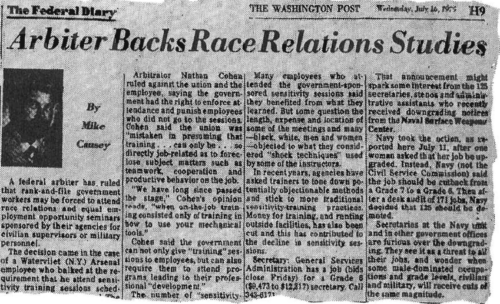
    WASHINGTON POST story tells of Nathan Cohen decision compelling Federal workers to submit to sensitivity-training sessions. Applying many of the same techniques which were used to brainwash American POW’s in communist prison camps in Korea and Vietnam, Federal psychologists are able to control attitudes and opinions with a high degree of success. These techniques are also being used in high schools now to “adjust” White students to a multiracial environment.
In 1984, the well-known political horror-fantasy by George Orwell, it was called the Two Minutes Hate. At eleven o’clock each morning the workers in all government offices assembled in front of television screens for a sensitivity-training session in which they released their pent-up hostilities and became, thereby, better-adjusted subjects of Big Brother.

In 1975 they don’t call it the Two Minutes Hate, but it amounts to exactly the same thing. Federal employees are increasingly being forced to submit to mind-bending group-therapy sessions designed to suppress “undesirable” attitudes — primarily attitudes toward members of racial-minority groups — and mold their psyches in directions deemed more suitable by the clever people who plan the therapy sessions.


Beginning (appropriately) in the Department of Health, Education, and Welfare and the now-defunct Office of Economic Opportunity a few years ago, the government’s sensitivity-training program is gradually being extended to other Federal agencies, both in Washington and in the boondocks.

Many government workers are complaining about this not-very-subtle program of thought control, but a recent decision in the case of an employee at the Watervliet (NY) Arsenal indicates that Big Brother is determined to press on.

Backed by his union, the American Federation of Government Employees, the Watervliet Arsenal employee argued that the government unjustly suspended him from his job without pay when he refused to attend sensitivity-training sessions which had been scheduled for workers at the arsenal.

A Federal labor arbitrator, Nathan Cohen, ruled against the union and the employee, saying the government has the right to enforce attendance and punish employees who do not go to the sessions. Cohen’s ruling will not halt all employee resistance to compulsory sensitivity training, but it will give the government an advantage in being able to threaten with dismissal all Federal workers who balk.

The Federal thought-control program is most solidly established in the Department of Defense. Under Secretary of Defense James Schlesinger sensitivity training has been institutionalized in each of the armed services as a mandatory part of the training of all personnel.

Some of the “shock techniques” used in earlier military sensitivity-training sessions are primarily responsible for the notoriety the program has received. Stripped of all insignia of rank, officers and enlisted personnel, Black and White, male and female, were herded into classrooms and subjected to various experiences designed to rub their noses collectively in the filth of racemixing.

In some sessions Black instructors would scream obscenities at White participants and encourage them to reciprocate: “You White honky motherfucker, call me a nigger! Come on, you honky bastard, you’re thinking ‘nigger’; now say it! ” The idea was to bring latent racial hostility to the surface, so that it could be dissipated.

In one Navy program at Charleston, S.C., a Black instructor took a White female assistant to the front of the class and fondled and kissed her, after a series of obscene “bedroom” remarks. The Navy received such strenuous objections to this program that it was temporarily halted.

But Federal psychologists have found that they are able to achieve their purpose just as well with more subtle techniques. One “final exam” devised by the mind-controllers, for example, simply involves passing a soft drink around the sensitivity-training classroom. Anyone in the racially mixed group who declines to take a drink from the common bottle is considered to have flunked.

Herd instinct — the drive to conform to group standards — is very powerful, and Big Brother’s experts have learned how to manipulate it in such a way that they can modify the opinions and attitudes of their subjects. The basic method used is to strip the individual’s personality naked, to deprive him of his privacy, to make him bare his innermost thoughts and feelings—and then to apply overwhelming pressure to him to make those thoughts and feelings conform to those of the others in the group. In the context of the sensitivity-training class, to be non-conforming is equivalent to being anti-social.

And the method works. Only persons of extraordinarily strong will and personality are immune to its effects.

Unfortunately, employees of the Federal government are not the only persons being subjected to the new thought-control program; workers in some industrial plants with Federal contracts are also being required to attend therapy sessions. Worse, pilot programs have been established in a number of the nation’s high schools.

Whereas the program for adults aims primarily at keeping natural racial hostilities in check, the high school programs are more ambitious. Their purpose is to utterly destroy any sense of racial identity in young Whites, to nip in the bud any incipient feeling of racial pride and replace it instead with self-hatred and guilt. The sensitivity trainers want to produce a new generation of racially castrated Whites — raceless White zombies who will blend unobtrusively into the multi-racial future they are planning for America.

In most cases the high school programs have adopted formats rather similar to the adult program, except that they have taken full advantage of the greater impressionability of their participants. But the thought-controllers are always experimenting, attempting to improve their craft.

One of their newer inventions is a “White studies” course for the White minority at the mostly Black Berkeley (CA) High School. It is called “What Is White?”

As proudly reported in the June 30 issue of Newsweek, the course complements “Black studies” courses in which Black students are taught that the only reason their race has a record of failure and lack of achievement throughout history is that the wicked and greedy Whites have held them back. Berkeley’s new “White studies” course teaches young Whites that they must accept the guilt for White repression of non-White races and try to make it up to them.

“After exploring such topics as prejudice and white culture,” reports Newsweek, the White students “come around to the view that the white man’s burden of guilt for America’s imperfections is really an opportunity and that there is much whites can do to help because of their position in society.”

One student who took the course, 17-year-old Anthony Cody, said: “I feel better about being white now. The course gave me the ability to deal with it.”

When the time comes to settle scores in America, there will be no place in hell hot enough for the depraved creatures responsible for destroying the racial consciousness of these White boys and girls. Meanwhile, however, the thought-controllers are going ahead as fast as prudence allows, and the number of young people being subjected to their program is growing at an alarming rate.

Unless Americans who still have the capacity to think for themselves act soon, that capacity may be taken from them; certainly it will be taken from their children. Unless we upset Big Brother’s plans, 1984 may be here in less than nine years.

* * *
Transcribed by Vanessa Neubauer from the book The Best of Attack! and National Vanguard, edited by Kevin Alfred Strom -- source: http://whitebiocentrism.com/viewtopic.php?f=25&t=1225

Zionism I: Theory


From Attack! tabloid, No. 42, 1976

Zionism I: Theory
Exclusiveness, Belief in Superiority, Hostility

by Dr. William L. Pierce

The Resolution by the General Assembly of the United Nations on November 10, equating Zionism and racism, has provoked a torrent of response in the news media. Much of this response has been deliberately deceptive, and there consequently exists a state of confusion in the average citizen’s mind as to just what Zionism is and what its relationship is, if any, with racism.

Image

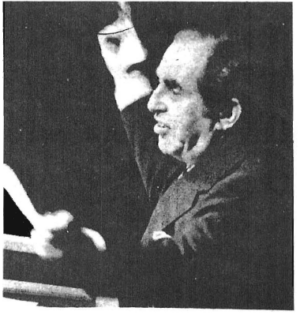
    Israeli Ambassador to the UN, Chaim Herzog, sneers at “goyim” in the UN General Assembly as he contemptuously tears up their resolution condemning Zionism. It is arrogant behavior like this which has earned the Jews the well-deserved hatred of all the other peoples of the world.

The Jewish response to the UN action, has been to deny that Zionism is racism and to charge to the contrary that anti-Zionism is merely a thinly veiled anti-Semitism. Jews maintain that Zionism, with its call for an exclusive Jewish homeland comprising Palestine and portions of other Arab countries, cannot be separated from Judaism and the Jewish people. In the words of Chaim Herzog, Israeli ambassador to the UN:

“Zionism… is the modern expression of the ancient Jewish heritage. The Zionist ideal, as set out in the Bible, has been and is an integral part of the Jewish religion.”

The Jews are essentially correct in asserting that one cannot be against Zionism without also being against Jews. Even though many Jews do not participate actively in any of the numerous Zionist political organizations, it is an undeniable fact that Jews, non-religious as well as religious ones, are nearly unanimous in their support for the government of Israel and for the political goals of Zionism.

Those who oppose Zionism or who are totally indifferent to it are an utterly insignificant minority. As Israel’s leaders are fond of boasting, “The Six Day War (of June 1967, in which the Jews seized Egypt’s Sinai, Jordan’s West Bank, and Syria’s Golan in a surprise assault on their Arab neighbors) Zionized world Jewry.”

Norman Podhoretz, editor of Commentary, the organ of the powerful American Jewish Committee, says essentially the same thing: “It has become clearer and clearer that something has happened to the Jews of America: they have all been converted to Zionism.”

But is Zionism equivalent to racism? Jews are the very image of wounded innocence as they hotly deny this. They correctly point out that Jews have been the instigators, the financiers, the propagandists, the generals, and, to a great extent, the soldiers in the war against racism, both in the United States and in other parts of the world.

As just one example, the most important organization in America seeking to bring about racial mixing between Blacks and Whites, the National Association far the Advancement of Colored People, has been an almost exclusively Jewish enterprise from its founding by Jews in 1910 until the death of its last Jewish president, Kivie Kaplan, last year. A Jewish lawyer, Jack Greenberg, still heads the NAACP Legal Defense Fund, which has instigated most of the moves toward court-enforced racial mixing in the last 25 years, including the original school-integration decision by the Supreme Court in 1954, from which all of today’s forced-busing orders have stemmed.

And the record of votes by Jewish legislators in the Congress and statements by Jewish spokesmen in the media is clear: they overwhelmingly favor all moves, including the racial busing of school children, which bring about increased racial mixing.

In other countries it is the same story. In South Africa, for example, the crumbling of the government’s policy of apartheid and the decision to abandon Rhodesia are the direct result of Jewish pressure. Harry Oppenheimer, the Jewish multibillionaire who controls the De Beers diamond mines, practically all of South Africa’s gold mines, her uranium industry, and a dozen other South African industries as well, has used his enormous wealth to buy control of many of the English-language news media in South Africa and has made substantial inroads into Afrikaans newspapers and magazines. He uses his media control to propagandize for Black-White “equality” and eventual Black rule for South Africa while simultaneously applying more direct pressures to government officials. He is supported in his efforts by South Africa’s very substantial Jewish community.

So, if nearly all Jews are Zionists and if nearly all Jews believe in racial mixing, how can Zionism be a form of racism?

In trying to answer this question, it is helpful to consider what a few prominent Zionists have had to say about Zionism. Moses Hess (1812-1875) is regarded as the real father of the modern, political form of Zionism. In his book Rome and Jerusalem, published in 1862, he wrote:

“We Jews shall always remain strangers among the goyim (Gentiles)… It is a fact that the Jewish religion is above all Jewish nationalism… Each and every Jew, whether he wishes it or not, is automatically, by virtue of his birth, bound in solidarity with his entire nation… One must be a Jew first and a human being second.”

Hess was more a Jewish nationalist than a Jewish racist — although he clearly did consider Jewishness to be a matter of birth rather than conviction. Other Zionists were much more explicit on this point. Louis Brandeis, a former U.S. Supreme Court justice and a leading Zionist, stated it succinctly: “Jews are a distinct nationality of which every Jew, whatever his country, his station, or his shade of belief, is necessarily a member.”

The Zionist historian Simon Dubnow wrote in his book, The Foundation of National Judaism (published in 1906):

    Assimilation is common treason against the banner and ideals of the Jewish people… But one can never ‘become’ a member of a natural group, such as a family, a tribe, or a nation. One may attain the rights or privileges of citizenship with a foreign nation, but cannot appropriate for himself its nationality too. To be sure, the emancipated Jew in France calls himself a Frenchman of Jewish faith. Would that mean, however, that he became a part of the French nation, confessing to the Jewish faith? Not at all. Because in order to be a member of the French nation one must be a Frenchman by birth, one must be able to trace his genealogy back to the Gauls, or to another race in close kinship with them, and finally one must also possess those characteristics which are the result of the historic evolution of the French nation. A Jew, on the other hand, even if he happened to be born in France and still lives there, in spite of all these, he remains a member of the Jewish nation, and whether he likes it or not, whether he is aware or unaware of it, he bears the seal of the historic evolution of the Jewish nation.

All three Zionists quoted above may be correctly regarded as racists, in that they reject the prevailing notion of the day that only the individual has any real significance and that it is wicked even to take into consideration the biological and cultural connections of the individual to a “natural group” (to use Dubnow ‘s term) of which he is a member.

It can be argued, nevertheless, that Jewish racism is at least a little different from the racism of most other peoples, in that it does place relatively less emphasis on purely biological connections and relatively more on other tribal connections: a shared culture, history, and attitude toward the non-Jewish world.

But this is to be expected in a people who exhibit as much biological diversity as the Jews do. They have absorbed physical traits from many of the other races among whom they have lived, until today, although most Jews still have many racial factors in common, they cannot be easily classified as a distinct race — and certainly not as a homogeneous race.

That which defines the Jews is only partly racial. They are also a partly national, partly religious, partly historical, partly cultural entity.

Indeed, because Jews are much more uniform psychically than physically, it is very difficult to decide whether they are more nearly a racial entity or a cultural entity. But that may be an irrelevant point. The fact is that Jews, now and always, have regarded themselves as a distinct, separate, and very special category of people — the “chosen people,” the “people of God,” and, as such, superior to all other peoples of the earth.

This idea that all Jews, whatever the country of their birth, are members of a single tribe, separate from and superior to all others, is the central theme of Zionism and of Judaism. Nahum Goldmann, president of the World Zionist Organization, touched on it when he said:

    "Diaspora Jewry (all Jews outside Palestine) has to overcome the conscious or subconscious fear of so-called double loyalty. It has to be convinced that it is fully justified in tying up its destiny with Israel’s. It has to have the courage to reject the idea that Jewish communities owe loyalty only to the states where they live.”

Image


    Nahum Goldmann, top Zionist leader. He speaks openly of a “Jewish race” and urges Jews everywhere to be loyal only to Israel.

Dr. Goldmann expressed himself more clearly in addressing the Jews of Germany, before World War II, attempting to persuade them to emigrate to Palestine:

    Judaism can have nothing in common with Germanism, if we go by the standards of race, history, and culture, and the Germans have the right to prevent the Jews from intruding into the affairs or their volk… The same demand I raise for the Jewish volk, as against the German… The Jews are divided into two categories, those who admit that they belong to a race distinguished by a history thousands of years old, and those who don’t. The latter are open to the charge of dishonesty.

If the racism expressed by Goldmann in the above statements were all there is to it, it would be hard to find fault with Zionism. Racism — the feeling of belonging to a “natural group,” of owing loyalty to that group, of wanting to preserve its identity and promote its welfare, of preferring to associate with members of that group rather than with aliens — is a universal, natural, and healthy condition of mankind. Indeed, it is a natural condition of all living things, in a sense, and they all owe their very existence to its universality.

But Zionism — whether one prefers to call it Jewish nationalism or Jewish racism — goes far beyond that. It is a distorted racism, a perverted and predominantly negative racism, expressing itself more in hostility toward other peoples than in positive aspirations for the Jewish people.

This has been true from the time of Moses, who instructed his fellow Jews to massacre without pity the Gentiles whose lands they wanted to seize, lest they later be inconvenienced by the survivors:

“But if ye will not drive out the inhabitants of the land from before you, then it shall come to pass that those which ye let remain of them shall be pricks in your eyes and thorns in your sides and shall vex you in the land wherein ye dwell.’” (Numbers 33:55)

The advice was generally followed in the old days, and it is still followed today. Joshua, after capturing the city of Jericho and looting it of all its “silver and gold and vessels of brass and iron”… “utterly destroyed all that was in the city, both man and woman, young and old, and ox and sheep and ass, with the edge of the sword.”

And, more than 3,000 years later, the Haganah and the Irgun and the Stern Gang massacred the entire populations of Palestinian villages in order to terrify the other Arab inhabitants of Palestine into fleeing the country and leaving their homes and farms and businesses to be taken over by Jews.

This hostility toward other peoples, this extreme Jewish xenophobia and ethnocentricity, this contempt for everything not Jewish is revealed over and over again in the writings of Zionists, just as in their actions. It is a masochistic sort of racism, which glories and revels in the anti-Jewish hostility which it in turn provokes.

Image


    This clipping from the November 21, 1975, issue of the Jewish Press, which claims to have the largest circulation of any English-language weekly newspaper for Jews, complains that Gentiles are “infiltrating” into Israel posing as Jews, thus “desecrating” the Jewish state and religion. In the eyes of orthodox Jews, “goyim” (Gentiles) are mere cattle, not human beings.

Theodor Herzl, the Zionist leader whose efforts were most essential to the founding of the state of Israel, wrote in his book The Jewish State (published in 1896):

    Every nation in whose midst Jews live is, either covertly or openly, anti-Semitic… Anti-Semitism increases day by day and hour by hour among the Gentiles… We are one people — our enemies have made us one in our despite… Distress binds us together, and, thus united, we suddenly discover our strength.

The Zionist Jakob Klatzkin (1882-1948) carried the idea further in his book Crisis and Decision, published in 1921, and addressed to the German people:

    …We are not hyphenated Jews (i.e., German-Jews); we are Jews with no qualifications or reservations. We are simply aliens; we are a foreign people in your midst, and, we emphasize, we wish to stay that way. There is a wide gap between you and us, so wide that no bridge can be laid across. Your spirit is alien to us; your myths, legends, habits, customs, traditions and national heritage, your religious and national shrines, your Sundays and holidays… they are all alien to us. The history of your triumphs and defeats, your war songs and battle hymns, your heroes and their mighty deeds, your national ambitions and aspirations, they are all alien to us. The boundaries of your lands cannot restrict our movements, and your border clashes are not of our concern. Far over and above the frontiers and boundaries of your land stands our Jewish unity… Whosoever calls the foreign (Gentile) land a fatherland is a traitor to the Jewish people … A loyal Jew can never be other than a Jewish patriot… We recognize a national unity of diaspora Jews, no matter in which land they may reside. Therefore, no boundaries can restrain us in pursuing our own Jewish policy…

And the “American” Zionist, Samuel Untermyer, said in 1933: “Other races have come and gone. The Jew has survived. Persecution cannot crush him. The Jews are the aristocrats of the world.”

Such unbridled and reckless arrogance, stemming from the persistent Jewish notion that the children of Israel have been “chosen” to rule the world and must, therefore, remain aloof from the goyim, destined to be their slaves when the Messiah comes, has led to a great deal of friction between the Jews and their Gentile hosts throughout the ages. And yet even this negative and peculiarly Jewish form of racism could be tolerated, if that were all.

The Jews could all go off to the Middle East and finish butchering the Palestinians, or they could all settle on a large island by themselves somewhere, and they could then indulge their narcissist fantasies and their hatred of the rest of mankind to their hearts’ content, and we would not care.

But gathering the Jews of the world together in one place is not really part of the Zionist scheme. They want an exclusively Jewish homeland, all right, but they also want to maintain their death grip on the economies and the governments of the Gentile lands where they live as minorities. Zionism is built not only on the ideas of Jewish exclusiveness and Jewish superiority, but also on the idea of Jewish world dominion.

Not a world dominion achieved by force of Jewish arms or by any frontal assault on the hated goyische world, but a dominion brought about by infiltration and subversion, by the encouragement of weakness and decadence among the Gentiles, by the imperceptibly slow injection of a Jewish spiritual poison into the hearts and minds of the goyim, destroying their will to resist.

And therein we have the explanation of the seeming dilemma: Jews who have devoted all their talents and energies to combatting racism being themselves charged with racism by the world community. Yes, Jews are against racism — racism among the Gentiles, that is, because they want to destroy the unity of the Gentile nations. And, yes, Jews (or Zionists, if you prefer) are racists, because they, more than any other people, realize the necessity of maintaining their own unity.

The condemnation by the United Nations of Zionism is, on the whole, a welcome move, but it nevertheless fails to face the issue as squarely as it should. The UN has condemned the Jews for their behavior in Palestine, for practicing both physical and cultural genocide against the Palestinian people. But that is only a negative form of the same racism which is practiced by all healthy peoples. What the Jews are doing to the Palestinians is what the Turks did to the Armenians, what the Serbs did to the Croats, what the American pioneers did to the Indians, what the Germans did to the Jews (although hardly to the tune of 6,000,000 as the Jews claim). It is the way of the world, even if, in our Western squeamishness, we would like to see more positive and fewer negative expressions of this natural and universal racism.

And so, in this regard, the Jews are at least justified in their claim that the UN condemnation of Zionist racism is hypocritical, because most of the members of the UN practice their own forms of racism. But if the UN were really an honest organization, it could have issued a denunciation of Zionism against which the Jews would have no defense.

Image


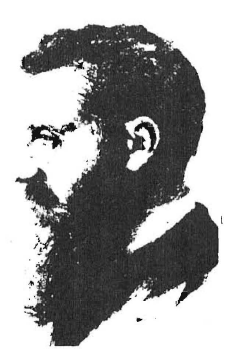
    Theodor Herzl, one of the “founding fathers” of Israel. He dreamed of an all-Jewish state from which the Gentile world would be ruled, in fulfillment of Jewish “prophecies.

The UN could have pointed out that Jewish racism is a unique evil — a unique danger to the world — not because the Jews want Palestine all to themselves or even because they aspire to world rule, but because of the truly unique ways in which the Jews go about implementing their Zionist designs.

Recognizing more clearly than any other people the importance of racism as a natural defense — as Nature’s way of maintaining racial integrity — the Jews deliberately go about neutralizing the racism of their intended victims, thus destroying their unity, their cohesiveness, and their will to resist. It is a tactic which has proven extraordinarily effective in the past, a tactic to which the Western peoples in particular have proven susceptible.

It is for this reason that the Germans, the one nation in modern times which developed a defense against Jewish racism, named the Jews “der Weltfeind” — the world enemy.

* * *
Transcribed by Vanessa Neubauer from the book The Best of Attack! and National Vanguard, edited by Kevin Alfred Strom. Source: http://whitebiocentrism.com/viewtopic.php?f=41&t=1245&sid=b40b92cfbcd1ca411853eefc7d35a7e1

Wednesday, August 27, 2014

What Dr. Pierce did before he became radicalized racially


Electrically Induced Nuclear Quadrupole Spin Transitions in a GaAs Single Crystal

Phys. Rev. 129, 1965 – Published 1 March 1963
E. Brun, R. J. Mahler, H. Mahon, and W. L. Pierce

ABSTRACT

The direct induction of nuclear E2 spin transitions in a gallium arsenide single crystal by application of an external oscillatory electric field has been previously reported by some of the authors. This paper gives the results of a further investigation of the same phenomenon. Theoretical expressions are given for the equilibrium nuclear magnetization in a crystalline lattice under the combined influence of a static magnetic field, externally induced electric field gradients, and thermal spin-lattice interactions, for various relative orientations of the applied fields and the crystalline symmetry axes. The theoretical predictions were tested for the three nuclides Ga69Ga71, and As75 by using pulsed nuclear magnetic resonance techniques to sample the equilibrium magnetization in a GaAs crystal at 77°K under the influence of a uniform, externally applied, radio-frequency, electric field. A description of the experimental apparatus is given. The dependence of the quadrupolar saturation on both the electric field amplitude and the crystal orientation was measured. The angular dependence of the saturation was found to be in reasonable agreement with the theory.
DOI: http://dx.doi.org/10.1103/PhysRev.129.1965
  • Received 4 October 1962
  • Published in the issue dated March 1963

© 1963 The American Physical Society

Racial loyalty is not rocket science, but it was nice having a bona fide rocket scientist and former Physics professor like Dr. Pierce around to explain the necessity for it to our people in simple yet profound language.

Friday, August 22, 2014

Fichte & the German Nation


Fichte & the German Nation

Johann Gottlieb Fichte, 1762–1814
Johann Gottlieb Fichte was one of those rare men who are both thinkers and heroes. His challenging Wissenschaftslehre (“doctrine of science”) remains one of the most ambitious attempts to encompass the world and its meaning in a speculative philosophical system. In his elaboration of Immanuel Kant’s philosophy of ethical idealism, Fichte achieved a compelling synthesis of the complementary values of freedom and duty. His conception of the world as the material projection of an ultimately all-embracing World-Ego exercised a seminal influence on the Romantic movement, that radical reassertion of Aryan racial values which in Fichte’s time was displacing the shallow rationalism of the Enlightenment.
Yet it is as the hero who called for a regeneration of the German spirit in an epoch-making series of addresses in a conquered Berlin swarming with hostile French troops that Fichte will live on in the memory of his countrymen. In his Addresses to the German Nation, the philosophus teutonicus, as the patriot-poet Ernst Moritz Arndt dubbed Fichte, revealed a vision of his people’s destiny which transcends national boundaries and still beckons to our own and future generations for fulfillment.
In December of 1807, it seemed that Napoleon and his all-conquering French armies had extinguished the last ember of German nationhood. In the year before, the Holy Roman Empire, the only tangible expression of the political unity of the German nation, feeble though it was, had been dissolved. More important, Fichte’s adopted homeland, Prussia, had reaped the fruits of over a decade’s timidity and indifference to the fate of its German neighbors. On October 14, 1806, at the twin battles of Jena and Auerstädt, Napoleon’s troops had all but annihilated the once matchless Prussian military machine. After fleeing to Königsberg in East Prussia, the well-meaning but irresolute Hohenzollern, King Frederick William III, had been forced to sign away half his country’s territory in the humiliating Treaty of Tilsit. Prussia was further obligated to pay a crippling indemnity, and Berlin was garrisoned by French troops.
A TRIUMPHANT NAPOLEON leads his troops through the Brandenburg Gate into Berlin on October 27, 1806, thirteen days after annihilating the Prussian Army at Jena and Auerstädt. This pro-French painting, by Charles Meynier, scarcely exaggerates the acclaim turncoat Berliners showered on the emperor. Prominent among the supporters of the French conquerors were the members of a race synonymous with treachery. As one historian put it, “Only the Jews were wholeheartedly and unhesitatingly pro-French, since they knew that one of the [French] revolutionary principles was their political and social emancipation . . .”  Fichte, even when he had tended to support the ideals of the French Revolution, pointedly excluded the Jews from consideration as German citizens. In anticipation of the National Socialist program, he advocated their deportation from Germany.
A TRIUMPHANT NAPOLEON leads his troops through the Brandenburg Gate into Berlin on October 27, 1806, thirteen days after annihilating the Prussian Army at Jena and Auerstädt. This pro-French painting, by Charles Meynier, scarcely exaggerates the acclaim turncoat Berliners showered on the emperor. Prominent among the supporters of the French conquerors were the members of a race synonymous with treachery. As one historian put it, “Only the Jews were wholeheartedly and unhesitatingly pro-French, since they knew that one of the [French] revolutionary principles was their political and social emancipation . . .”
Fichte, even when he had tended to support the ideals of the French Revolution, pointedly excluded the Jews from consideration as German citizens. In anticipation of the National Socialist program, he advocated their deportation from Germany.
 
More ominous than the military collapse of Prussia and the other German states was the concomitant decline in German morale. The purely dynastic patriotism which the various German princes had attempted to foster among their subjects had proved no match for the intense nationalism which spurred the French invaders. Although, predictably, Germany’s Jews had accorded Napoleon his most enthusiastic welcome, many a Berlin burgher had also cheered the triumphant entry of the French imperial army. Prominent citizens sought audiences with the emperor, and sycophantic writers wrote panegyrics to his genius.
In pointed contrast to Napoleon’s effusive admirers, German patriots had fallen silent, content to denounce the foreign oppressors only to their most trusted friends in the privacy of their drawing rooms. There was ample justification for their timidity. French spies and German informers in their service were everywhere, and the French censors had more than blue pencils at their disposal.
Little more than a year before, Johannes Palm, a Nuremberg bookseller, had been arrested in connection with the writing and circulation of an anonymous anti-French pamphlet entitled Germany in Her Deepest Humiliation. He had been betrayed to the authorities by a German policeman. On August 26, 1806, Palm had been shot in the little Austrian town of Braunau-on-the-Inn (which, 83 years later, was to acquire even greater cause for the veneration of German patriots).
In these desperate circumstances, the philosopher Fichte resolved to speak out publicly in the cause of the German nation. He had accompanied the Prussian court and the remnants of Prussia’s battered army to Königsberg in 1806. There, his reputation for radicalism had frustrated him in his attempts to be appointed field preacher to the troops. Disappointed but still overflowing with determination to rekindle the German spirit, Fichte returned to Berlin in August 1807.
He took up residence with his family in the secluded Georgengarten, in a section of Berlin rarely frequented by the French soldiers. In the following months, he immersed himself in the writings of Machiavelli and the Swiss educator Pestalozzi, but above all in the Annalsof Tacitus, in which the heroic deeds of Hermann the Cheruscer against the Roman legions find their echo.
Drawing on these writers for inspiration, Fichte began to compose a series of lectures which incorporated the spirit of Machiavelli’s and Hermann’s fervent patriotism, and drew on Pestalozzi’s concrete proposals for educational reform. Professor Fichte (who was at that time a member of the faculty of the University of Erlangen) announced the addresses in a brief notice in the Vossischer Zeitung, one of the leading Berlin newspapers of the day. According to the announcement, the lecture series was to be the continuation of a popular course Fichte had delivered in Berlin three years before, which he had titled The Characteristics of the Present Age.
The Berliners who crowded the amphitheatre of the Academy of Sciences at noon on Sunday, December 13, 1807, were doubtless drawn by more than intellectual curiosity. Fichte had never shrunk from controversy, particularly in addressing the vital questions of the day, nor did he show any qualms in skewering his intellectual opponents on the sharp prongs of his scathing polemics. Would he be as forthright in dealing with the French?
There was also the problem of continuity with the previous lecture series. Attentive students of Fichte could recall that in his Characteristics addresses, the philosopher had represented himself as something other than the fervent patriot he had revealed himself to be in the intervening years. In fact, Fichte had proudly boasted of a cosmopolitanism in which “we ourselves and our descendants can remain indifferent forever to the affairs and fates of nations and states.” How were these sentiments to be reconciled with Fichte’s present stance?
Fichte was not unmindful of Palm’s fate. Later, during the course of his lectures, he wrote to his friend, the Prussian counselor Beyme: “I know full well what I am risking; I know that I can be shot just like Palm. But I have no fear, and would gladly die for the realization of my goal.”
Elsewhere Fichte wrote: “The only decisive factor is, can you hope that the good to be accomplished is greater than the danger to be risked? That good is inspiration, exaltation. My personal danger doesn’t matter; rather, it could be extremely advantageous. My family and my son would not lack the nation’s assistance; my son would reap the benefits of his father’s martyrdom. That would be the best outcome. I couldn’t make better use of my life.”
Fichte dedicated his life not only to finding the truth but to proclaiming it to the world, regardless of the consequences. His stirring Addresses to the German Nation, delivered at the risk of arrest or even death at the hands of the French authorities, marked the dramatic high point of his public career, but his contributions to the philosophical basis of the Romantic movement were even more valuable to his posterity. Fichte stressed the importance of intuitive knowledge, that deep wisdom which lies in the race-soul and is sustained by the Universal Consciousness.
It was in this spirit that Fichte inaugurated his Addresses to the German Nation. On the podium of the packed amphitheatre, he presented a commanding appearance. Short but robust, his sharp features radiated firmness of purpose. As Immanuel Hermann Fichte, his son and biographer, later wrote, “Fichte’s words in his lectures sweep along like a storm cloud that sheds its fire in separate strokes. He does not move, but he uplifts the soul.”
Fichte immediately established the connection with his lectures on The Characteristics of the Modern Age. In the Characteristics, Fichte had developed a scheme of five successive ages, somewhat similar to that propounded by the great German dramatist and critic Gotthold Ephraim Lessing some years before. According to Fichte, human history was a process of evolutionary progress, yet during the Enlightenment the all-too-rapid supersession of the age of blind faith and obedience by a human reason not yet anchored in a foundation of a real knowledge had ushered in an age of “completed sinfulness.”
Now, Fichte proclaimed, the age of completed sinfulness had come to an end, and it was the task of the Germans to lead all mankind to a new epoch of liberation. Despite his universal aims, Fichte made clear that he spoke “only of Germans and only for Germans.” It was only the German people who had the qualities of character demanded for initiating the new era. But first it was necessary “to avert the downfall of our nation, which is threatened by its fusion with foreign peoples, and win back again an individuality that is self-supporting and quite incapable of any dependence on others.”
From time to time as Fichte spoke, the blare of martial music reached the ears of his listeners. The broad Berlin avenue Unter den Linden ran past the Academy of Sciences, and Napoleon’s officers staged frequent parades to maintain the Ã©lan of their troops.
Within the amphitheatre itself there were Berliners whose attentiveness was neither the product of patriotic ardor nor of a thirst for philosophical enlightenment. They were well known to be informers to the French authorities, and they pricked up their ears to catch any hints of rebelliousness against the rule of the heralds of the “Rights of Man.”
Fichte had cleverly anticipated them. It was not his purpose to castigate the French so much as to promote a German national revival. Besides, as he pointed out, it was not at that time possible to dislodge the conquerors by merely military means. Despite his surface disavowal of anti-French aims, however, Fichte never missed an opportunity, all through the Addresses, to belabor the French and, indeed, Napoleon himself, with a characteristically French irony, which evidently eluded the French military government’s journeymen snoops.
The solution which Fichte offered to the ills which beset the German nation, both at the hands of the French and in the context of the self-seeking which had pervaded all classes in Germany even before defeat, was “a total change of the existing system of education.” In its place was to be instituted a system of national education (Nationalerziehung), to apply to “every German without exception, so that it is not the education of a single class, but the education of the nation, simply as such and without excepting any of its individual members.”
Fichte concluded his first address with an inspirational evocation of his purpose in speaking out: “The dawn of the new world is already past its breaking; already it gilds the mountaintops, and heralds the coming day. I wish, so far as in me lies, to catch the rays of this dawn and weave them into a mirror, in which our grief-stricken age may see itself; so that it may believe in its own existence, may perceive its real self, and, as in a prophetic vision, may see its own development, its coming forms pass by.”
Fichte’s own life and intellectual development uniquely qualified him for his role as herald of Germany’s awakening. The philosopher’s career provides ample evidence of his own possession of those qualities of mind and will which he sought to instill in others, in sharp contrast to certain other world-betterers (Rousseau and Marx spring to mind).
Johann Gottlieb Fichte was born on May 19, 1762, in Rammenau, Upper Lusatia, in what was then the electorate of Saxony. His origins were humble. His father was a weaver, his mother a woman of simple piety. When Fichte was nine, his quick intelligence caught the eye of a local nobleman, Baron von Miltitz, who decided to sponsor his education. After two years of instruction at a neighboring parsonage, Fichte was enrolled in the renowned Schulpforta, a private boarding school which today numbers, in addition to Fichte, the poet Klopstock, the historian Ranke, and the philosopher Nietzsche among its illustrious alumni.
The education which Fichte acquired at Schulpforta qualified him for membership in Germany’s intellectual elite without estranging him from a consciousness of himself as a man of the people. When Fichte was forced to abandon his university studies after only a year, due to his patron’s death, his democratic feelings were reinforced by nearly a decade’s experience as a tutor to the sons of the noble and wealthy. Treated as little better than a servant by his wealthy employers, Fichte gained a life-long contempt for the aristocracy.
The turning point in Fichte’s life came with his introduction, by a university student whom he was tutoring, to the philosophy of Immanuel Kant. Fichte immediately embraced Kant’s rejection of the shallow rationalism and materialism in vogue in German and French philosophy during the 18th century, as well as his “intuitive” justification of God and the immortality of the soul. Fichte quickly mastered Kant’s philosophy and in 1791, with Kant’s approval, anonymously published A Critique of All Revelation, which was immediately taken to be Kant’s own work. When Fichte’s authorship became known, his reputation was assured. Shortly thereafter, at the urging of Goethe, Fichte was appointed a professor of philosophy at the University of Jena in Saxe-Weimar.
While at Jena, Fichte evolved his Wissenschaftslehre, in which he dispensed with Kant’s concessions to a reality capable of being objectively apprehended in favor of a world view based entirely on the supremacy of the mind and the will. Among the students he decisively influenced were the poet Novalis, the philosopher Schelling, and the Schlegel brothers, who were both to become outstanding philologists.
In 1799, Fichte was forced out of Jena following a controversy worked up by his opponents around the specious charge that Fichte was an atheist. Departing the allegedly tolerant Saxe-Weimar, he found a ready reception in absolutist Prussia.
In Prussia, Fichte began to develop his philosophy in a direction which took more cognizance of the importance of the nation and the state in providing the conditions under which knowledge and virtue might be attained and cultivated. In 1800 he wrote The Closed Commercial State, which sought to harmonize the exigencies of economic justice and the needs of the state. As the first description of a national socialism in other than utopian terms, The Closed Commercial State had no small influence on future political thought in Germany.
By 1806 Fichte had evolved the essentials of the ideology of German nationalism which animated the Addresses to the German Nation.
Despite Fichte’s situation of the Addresses in the context of his complex Wissenschaftslehre, their central thesis—that Germany’s rebirth was to be accomplished through a program of “national education”—is relatively easy to grasp. The ideas which underlie this thesis, however, require a certain amount of elucidation, especially for the modern reader.
Those who approach the Addresses in anticipation of a supercharged distillate of anti-French, patriotic fustian will doubtless be disappointed. Fichte’ s purpose in delivering the Addresses was not so much to excoriate the Corsican tyrant and his French (and German) minions as to galvanize his fellow Germans into effective thought and action.
Americans weaned for two generations on propaganda depicting the Germans as frenzied chauvinists will have difficulty in visualizing the degree of indifference to Germany’s political fortunes which prevailed among German intellectuals in Fichte’s time. During the previous 50 years the leading writers and thinkers of Germany had emancipated the nation’s literature and philosophy from their slavish imitation of French models. Yet, in the political sphere, the ideal of men such as Goethe and Kant remained a hazy cosmopolitanism.
Goethe, in particular, affected an Olympian detachment, going so far as to receive Napoleon cordially when the emperor passed through Weimar. As we have seen, even Fichte was long able to delude himself in the notion that he, too, was a “citizen of the world.”
The special task which Fichte set himself in the writing the Addresses to the German Nation was to imbue educated Germans with a sense of national mission. To that end, he played on the feelings of cultural and linguistic pride which German intellectuals had developed over the preceding decades.
Fichte argued that the German Volk was superior in character to those peoples in Europe, often originally German, who had abandoned their original languages for new ones derived from Latin. Drawing heavily on the theories of the philologist and literary critic August Wilhelm von Schlegel, Fichte differentiated between German, a “living language” or “original language” (Ursprache), able to form an intellectual and philosophical vocabulary from its own roots, and the Romance languages, which were forced to draw their scholarly words from a dead language.
According to Fichte, this reliance (in the case of the German language) on native words with concrete connotations to depict the “supersensuous” insured a clarity and honesty of expression sadly lacking in such languages as French and Italian. In fact, the Germans owed their “honest diligence and earnestness in all things” solely to their language.
Unwieldy as this sort of bold reductionism strikes us today, Fichte made good use of it in stirring national pride. Despite his ignorance of the biological factors underlying group differences, Fichte was unerring in delineating the strong points of the German character. In a memorable passage, he described the German spirit as “an eagle, whose mighty body thrusts itself on high and soars on strong and well-practiced wings into the empyrean, that it may rise nearer to the sun whereon it delights to gaze,” in contrast to the less inspired Latin peoples, whose genius he likened to “a bee, which with busy art gathers the honey from the flowers and deposits it with charming tidiness in cells of regular construction.”
Having established at length the worth of German culture and character, Fichte emphasized that the German language, the basis of character and culture, was in danger of disappearing in a Germany dominated by aliens. (“Where a people has ceased to govern itself, it is equally bound to give up its language and coalesce with its conquerors, in order that there may be unity and internal peace and complete oblivion of relationships which no longer exist.”)
The system of national education which Fichte proposed to insure the future survival of the German language—and, thus, of the German people—embodied a far more radical conception than is perhaps evident at first glance. The idea of inculcating in an elite a virtue which can only be acquired through knowledge goes back at least as far as Plato’s Republic. Fichte revised this idea by boldly mandating such an education for the entire youth of the nation.
In the words of Fichte, “So there is nothing left for us but just to apply the new system to every German without exception, so that it is not the education of a single class, but the education of the nation, simply as such and without excepting any of its members. In this, that is to say in the training of man to take real pleasure in what is right, all distinction of classes which may in the future find a place in other branches of development will be completely removed and vanish. In this way there will grow up among us, not popular education, but real German national education.”
The educational system which Fichte envisioned was indebted to the theories of Johann Heinrich Pestalozzi, a Swiss who had made his life’s work the education of the children of the poor. In contrast to the force-feeding of the intellect which was the staple of rationalist educational practice, Pestalozzi laid stress on the development of the child’s character. To this concern Fichte added a special emphasis on the training of the will, which he felt had long been greatly neglected by German educators. Briefly, Fichte’s conception of national education was “the art of training the whole man completely and fully for manhood.”
According to Fichte, “When once the generation that has been formed by this education is in existence—a generation impelled by its taste for the right and the good and by nothing else whatever; a generation provided with an understanding that is adequate for its standpoint and recognizes the right unfailingly on every occasion; a generation equipped with full power, both physical and spiritual, to carry out its will on every occasion—when once this generation is in existence, everything that we can long for in our boldest wishes will come into being of itself from the very existence of that generation, and will grow out of it naturally.”
Fichte concluded the Addresses with some of the most stirring oratory in the German language. He threw down a challenge to his German hearers in these words: “Review in your own minds the various conditions between which you now have to make a choice. If you continue in your dullness and helplessness, all the evils of serfdom are awaiting you; deprivations, humiliations, the scorn and arrogance of your conqueror; you will be driven and harried in every corner, because you are in the wrong and in the way everywhere; until by the sacrifice of your nationality and your language, you have purchased for yourselves some subordinate and petty place, and until in this way you gradually die out as a people. If, on the other hand, you bestir yourselves and play the man, you will continue in a tolerable and honorable existence, and you will see growing up among you and around you a generation that will be the promise for you and for the Germans of most illustrious renown. You will see in spirit the German name rising by means of this generation to be the most glorious among all peoples; you will see this nation the regenerator and re-creator of the world.”
As is well known, Fichte’s Addresses helped fan the dying embers of German national feeling into a raging inferno which swept the French invaders from the fatherland in the Wars of Liberation five years later. Yet Fichte’s radicalism in demanding a united Germany organized along the lines spelled out in his Addresses waited a century and a quarter for its brief realization. In the short period of Germany’s resurgence under National Socialism, Fichte’s ideal of a generation of German youth steeled in character and will first began to take shape.
Fichte’s courage in saying what had to be said at the risk of his own life in 1807 should serve to embolden White men and women in possession of the truth today to speak out unhesitatingly. The philosopher’s vision of a national education cutting across class lines and embracing the whole people to mold young men and women into principled members of their nation and race will remain a beacon urging us on to the future reality.
Originally published in National Vanguard, no. 58, 1978; reprinted in The Best of Attack! and National Vanguard Tabloid, ed. Kevin Alfred Strom (National Vanguard Books, 1984). This format from: http://www.counter-currents.com/2013/06/fichte-and-the-german-nation/#more-40286