Sunday, December 22, 2013

Role of the Church


Soweto Christian Gospel Choir performs in Chicago, Illinois

The times, they are a-changing, and Western man’s institutions are changing too. One of these institutions is organized Christianity: the Church. (“The Church” – with a capital “C” – hereinafter is used in a collective sense, encompassing all organizations which embody the established Christian sects, both Catholic and Protestant, except where the context indicates a specific denomination.)

The Church has endured as a Western institution for about a thousand years – even longer in some parts of the West – but it is now feeling the hurricanes of change and responding to them more strongly than many new institutions.

Spiritual Masochism

Some recent news items concerning the Church will serve as illustrations of the changes which are taking place or have taken place: “The Church’s chief source of income today is women’s vaginas,” the invited speaker explained to her audience at Notre Dame. The assembled Catholic students and faculty listened attentively as Women’s Libber Ti-Grace Atkinson carried her theme back to the time when Mary “was knocked up” and then went on to predict that Catholic women would put an end to this exploitation by destroying the Church, because “the motherfucker belongs to us.”

There was a minor stir inside the United Presbyterian Church (a very minor stir, involving only two congregations) when it was disclosed at the denomination’s 1971 general assembly that a $10,000 contribution from the church’s treasury had been made to aid the legal defense of Angela Davis. Church officials justified the grant as helping to assure a fair trial for the communist Negress, who was charged with complicity in the murder of a judge and three other persons in a shootout staged by Black militants at a Marin County, California, courthouse.

The First Presbyterian Church of Tacoma, Washington, and the First Presbyterian Church of Anchorage, Alaska, however, expressed displeasure and indicated that they preferred the money their members put in the plate each Sunday not end up in the Communist Party’s legal defense fund.

Not to be outdone by the Presbyterians, the Episcopal Church revealed early this year that a $10,000 contribution from its treasury had gone to the militant Indian group which recently sacked the Bureau of Indian Affairs in Washington. The contribution was authorized by Black militant Episcopalian Leon Modeste, $23,500-a-year head of the Episcopal Church’s “Minority Empowerment Office.”

Unitarians sought last year to quash a grand jury subpoena requiring the production of the bank records of the Unitarian-Universalist Association. The subpoena was issued because Beacon Press, the Unitarians’ publishing house, had published the top-secret “Pentagon papers” stolen by Daniel Ellsberg and his associates.

The same Beacon Press advertising leaflet which listed 4 volumes of Pentagon papers (hardback: $45; paperback: $20) also offered the following Unitarian books: Three Documents of the National Liberation Front (“Americans may now judge for themselves whether the NLF (Viet Cong) principles are consistent with equity and their own sense of justice…”); The Vanguard, by Ruth-Marion Baruch (“A photographic study of the Black Panthers – eloquently capturing their spirits as well as their faces, attitudes as well as activities, in a uniquely personal and intimate introduction to youth and revolution.”); The Right of Revolution, by Truman Nelson (“For those who cannot understand the Black militants’ willingness to burn political bridges,  a gifted writer places new revolutionaries within our oldest patriotic tradition.”); Marriage in Black and White, by Joseph R. Washington, Jr. (“…racial conflict cannot be eliminated until we are willing to confront prejudice on its most personal level-by acceptance of intermarriage.”); and An Essay on Liberation, by Herbert Marcuse, the communist-Jewish senior theoretician.

Beacon Press, as a church organization, is exempt from federal taxes and mails its flyers at the special postage rates allowed to non-profit organizations.

The Massachusetts Bible Society has praised the efforts of a couple of modern Bible scholars, Walter A. Wolfram and Ralph A. Fasold, in its newsletter. Wolfram and Fasold have nearly finished their translation of the Bible into “Black English.”

Here’s the way the Gospel according to St. John reads in their translation: “God really did love everybody in the world. In fact, he loved every last one of those dudes so much that he done give up the onliest Son he had. Any man that believe in Him, he gonna have a life that ain’t never gonna end. He ain’t never gonna die.”

No Escape from Liberalism

The instances of change cited above may seem atypically bizarre to some churchgoers who have thus far escaped the mainstream of change and still preserve a pre-World War II, Norman Rockwellian image of the Church. Even the smallest backwater congregations, if they are linked by denominational ties to a national organization, must inevitably fall under the influence of national trends, however.

The immediate effect of the liberalization of the Church has been a drastic decline in its influence. During the 1960’s overall church attendance in North America dropped by more than one-sixth.

Young People Abandon Church

More significantly, in the age bracket 21-29 years church attendance dropped by one-third in the 1960’s and is falling even more rapidly in the 1970’s. During the same decade Bible sales fell 30 per cent.
All Christian sects are now experiencing a critical shortage of clergymen. More priests and ministers return to secular life every year, and fewer young men enter the seminaries. This sharp decline in the number of clergymen can be seen, for example, in the almost complete substitution of laymen for priests on the faculties of most church-owned schools.

************************
[T]he Church is not dying gracefully or with dignity
************************

Adapting to a TV Life-style

The Church, in attempting to adapt to radical changes in its environment, has, like the dinosaur, failed. Unlike the dinosaur, however, the Church is not dying gracefully or with dignity. Its attempts to maintain its grip have led it to plumb the depths of degeneracy in a degenerate age.

Traditional services and ceremonies of beauty and solemnity have been corrupted by the introduction of elements of “mod” culture. More and more they are taking on the aspects of “happenings,” with rock combos replacing organists and choirs, beads and psychedelic lights taking the place of vestments and candles, “swinging” ditties and jive-dialect Bible translations edging out the old hymns and the King James version.

Social Gospel

Sermons have, in recent years, been giving fairly short shrift to spiritual matters and instead have tended to become social-action harangues. The pulpit has, to a very large extent, become a sounding board for neo-liberalism.

In the more avant-garde denominations, the prestige attached to a minister is determined not so much by his ability to interpret Holy Writ for his congregation as it is by the number of times he has been in jail for pouring blood on Selective Service records or supplying the teenagers in his flock with pot.

Religious Thirst Unquenched by Modern Church

And yet, becoming “mod” and “relevant” has not won for the Church the affection of the present generation; it has only lost the respect of a portion of the old generation. Pot and pacifism and “love” have served as poor substitutes for reverence and awe.

But the Church is not dead yet. Left to its own devices, it would probably linger in the West for another hundred years or more before becoming a negligible factor in the overall scheme of things.

************************
The Church once stood as a bitter and determined opponent
of the communist movement. Today it has-at best- settled on
peaceful coexistence with this deadly enemy of mankind.
************************

Dying but Still Dangerous

Though the Church has lost its former position of absolute moral authority, tradition still lends a not inconsiderable weight to its influence. Many Christians who are no longer fervent in their adherence to the Church’s doctrines-even those who no longer attend church services-still allow their opinions and attitudes to be governed to a greater or lesser extent by the Church.

Unfortunately, this influence is being sadly misused. The Church, in turning away from purely theological matters and concerning itself primarily with politics and social and racial policies instead, has-on virtually every major issue-taken a position diametrically opposed to Western interests.

The Church once stood as a bitter and determined opponent of the communist movement. Today is has-at best-settled on peaceful coexistence with this deadly enemy of mankind. At worst-and this is becoming more common every day-it has become an enthusiastic collaborator, not only with formally recognized Marxist groups, but with practically every ragtag band of sub-men big enough to organize a street demonstration in the United States or overthrow the ruling clique in banana republic.

Church Now Racially Destructive

Most serious of all is the Church’s racial attitude. It is not simply that “racism” has become the No. One Devil, the only unforgivable heresy, the ultimate sin in the eyes of the Church, but all the major sects, Catholic as well as Protestant, have perversely embraced a program calculated to physically destroy the racial basis of Western man’s existence.

This program has already advanced to the stage where a number of church organizations have issued statements supporting-even urging-miscegenation by Christians.

Crimes Against God and Nature

A report released a few months ago by the Presbyterian Church in the United States, a predominantly Southern denomination, said that Presbyterian officials “recognize with appreciation the contribution to better human relations in the world community that may come from Christian marriage across cultural, national, and racial lines.” Another section of the report encouraged church members who are considering adoption to give serious thought to adopting Negro or Oriental orphans instead of White infants.

And the Presbyterian Church in the United States is no worse than other major denominations in this regard. Everyone has heard the insidious spot advertisements sponsored by various denominational groups which are intended to instill feelings of racial guilt in White listeners while undermining racial pride and solidarity.

Backing Black Terror

On the international level we have the sorry spectacle of such ecumenical groups as the National Council of Churches and the World Council of Churches lobbying viciously to isolate and undermine the independent White governments of Rhodesia and the Republic of South Africa.

Last September the World Council of Churches allocated $200,000 to support Black terrorist “freedom fighters” in Africa. Much of that money has already been spent on weapons and has allowed a number of terrorist raids to be launched from Zambia against White settlers in Rhodesia this year.

Likewise, in Australia the government’s abandonment of its former “White Australia” immigration policy was due to much pressure from the powerful Australian Council of Churches as from Jewish and Marxist groups.

Tragic Betrayal

The present racial policies of the Church are tragic and ironic, for it was Western man-and Western man alone-who built the Church.

For several centuries the interests of the race and the interests of the Church were one. It was under the sign of the cross that the Teutonic Knights conquered and civilized the lands of eastern Europe, that the Crusaders extended the Western imperium into the Orient, that our European ancestors defended the West against invasions by Moors and Mongol hordes.

The Church was, for hundreds of years, the principal repository for Western science and learning, the most important stimulus for Western creative and artistic energies. All the great artists of the Middle Ages, all the architectural splendors of Gothic Europe, much of the sublime music ever created drew their inspiration from the Church.

Subversion by Aliens

But the times have changed. Those who most bitterly resent the changes which have taken place in the Church place the blame in several areas.

Some see the problem as a matter of infiltration and subversion of the Church by alien elements. This is, indeed, not a new problem. It played a major role in bringing on the Spanish Inquisition in the 15th century, after Jewish converts, or marranos, began infiltrating the Catholic Church.

The infiltration has certainly increased since the 15th century, and it has had profound effects. For one thing, there has been a radical revision of the Church’s attitude toward Jews.

Bulwark Against Culture Distortion

Until recent times the Church was a major bulwark against Jewish influences in the life of the West. If the natural instincts of the people failed to keep the Jews at a distance, the Church was prepared to do so on purely religious grounds.

Now every bit of Church doctrine and liturgy has been carefully scanned and, wherever necessary, “modernized” to bring it into line with the new Judeo-Christian way of looking at things. Even the beautiful and moving Passion Play at Oberammergau has recently been twisted into conformity with the new line by removing or recasting all those portions which portrayed Jews in a bad light.

Putting Jews on a Pedestal

Lutherans and Presbyterians have recently begun publishing new Sunday school materials which no longer place the blame for the Crucifixion on the Jews (“We are all responsible”) but instead describe them in the same terms the Jews use in referring to themselves: “a special people,” “God’s chosen people,” etc.

The current trend toward ecumenicism is also tending to stress a connection between Christianity and Judaism.

Decadence is Major Factor

Others see the problem as a simple matter of decadence rather than deliberate subversion. In their view the really significant symptom is not the Red rabble-rouser-the Father Groppi-in the pulpit; it is the sincere Methodist minister, anxious to keep up the attendance-and the collections-at his Sunday services, who lies awake at night thinking of new Madison Avenue gimmicks to make his service “relevant.”

Regardless of the extent to which it is deliberate or involuntary, the fact is that the Church is suffering from exactly the same disease which has infected all the other institutions of Western civilization: neo-liberalism.

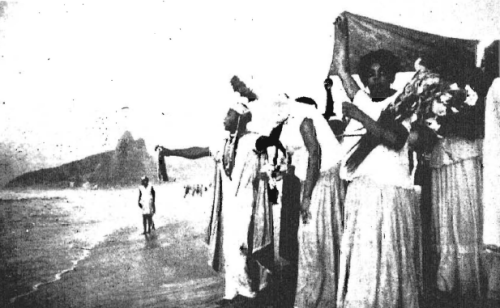
Mulatto Catholics in Rio de Janeiro celebrate the rite of an 
African spirit cult on the beach. They are offering a sacrifice 
to Iemanja, a sea witch. The Roman Catholic Church 
increasingly tolerates irregularities of this sort as the non-White 
membership of the Church grows. In some parts of Latin 
America Christian doctrine is so strongly modified by local 
paganism as to be barely recognizable.

Mulatto Failure

The burning zeal, the intolerance of heresy, the unquestioning devotion to the Faith-all the things that once gave the Church its vitality-are gone. What is left is an empty, materialistic shell.

The fervent men who once devoted their lives to the service of God have been replaced by Ivy League organization men who are eager to please, adapt, conform. They have held moistened forefingers to the winds of change and have let themselves be persuaded that those winds are blowing toward a mulatto future. And they want to get there ahead of everyone else.

A More Fatal Ill

Many Christians nurse the hope that the Church’s faults can be cured by rooting out the subversives and reversing the neo-liberal policies. They see the Church as a fortress of goodness, sorely beset now by its enemies but worthy of being defended and set right again, for the ultimate good of our race. They fail to see a more fatal ill.

That ill lies in the changing racial complexion of Christendom. The fact is that Christendom always has been, in theory, a community of faith rather than of blood. Just as with all cultural phenomena, the Church reflects the racial characteristics of the human masses who give it life. When the Holy Roman Empire was the secular arm of Christendom, those masses were substantially Aryan. Today they are not.

Approximately half the Christians in the world today are non-White, and by the end of this millennium non-White Christians will outnumber White Christians by three to two, if the present shift of Christendom’s center of gravity to the south continues. Regardless of the reasons for this shift, it is real and has proceeded far beyond any possibility of recall.

************************
[T]he Church can no longer be regarded as a Western 
institution, and those who serve it cannot also 
wholeheartedly serve our race.
************************

Cast Corruption Aside

Thus, the Church can no longer be regarded as a Western institution, and those who serve it cannot also wholeheartedly serve our race.

This poses a choice for every man and every woman of the West: a choice which will be difficult for some and easy for others, but a choice must be made.

The strongest and the best will make the right choice, for they will understand that their inner faith is the essence and the Church superficiality. While the superficiality can be corrupted, the faith can nevertheless be kept pure.

They will cast aside the corrupt and cling to the pure, and in the trials which lie ahead it will stand them in good stead.

From Attack! tabloid No. 19, 1973
Tuesday, December 3, 2013

Dr. William Pierce on the Difference between National Socialism and Fascism

03-17-2013 by James Harting 


The notion that the National-Socialism of Adolf Hitler is a type or variant of a more generally defined "fascism" is a staple of Marxist propaganda and analysis. Indeed, the Marxists have been so persistent and strident in making this false claim that it has infected the thinking even of some of those who claim to be NS themselves.

Back in 1970, Dr. William L. Pierce addressed this issue in his column "Questions & Answers for National Socialists," that appeared in WHITE POWER: The Newspaper of White Revolution, which was mass distribution tabloid of the National Socialist White People's Party. (Dr. Pierce is listed as the "Associate Editor" for the issue in which this particular column was printed.)

==========================

Q: Liberals often refer to National Socialists as "fascists." Are they correct in this practice?

A: Liberals apply the label "fascist" to anyone whose ideas they find abhorrent or dangerous--even conservatives. They tend to use this term as a smear word, not restricting it to the adherents of any specific ideology. Thus, they probably feel as justified in trying to smear us with the label "fascist" as any other of their opponents.

Q: Well, is it proper for National Socialists to refer to themselves as "fascists?"

A: Certainly not. When we use the term we are virtually always referring to the adherents of the specific social-political doctrine on which Benito Mussolini founded his governmental system in Italy--that is Fascist with a captial "F." Although it may not seem important to the liberal, there is a profound difference between National Socialism and Fascism.

Q: But I thought that both Fascism and National Socialism were highly centralized, authoritarian and strongly nationalistic forms of goverment, with only slight differences between the ways they operated.

A: You have been reading too many textbooks written by liberals. Certainly the Fascist state and the National Socialist movement are authoritarian, and they both have a strong social basis. Furthermore, both Adolf Hitler's National Socialist government and Mussolini's Fascist government administered most of their programs for national and social renewal on a centralized, nationwide basis. Both governments brought forth immense popular enthusiasm, which was manifested in numerous public demonstrations and celebrations. All these things contributed to a seeming similarity. But the differences betwen the two systems are by no means slight!


Q: What are some of these differences?

A: The really fundamental difference lies in the role of the state and the race under each system.

In Mussolini's word's:
"The Fascist conception of the state is all-embracing: outside of it no human or spiritual values can exist, much less have any real worth. Thus understood, Fascism is totalitarian, and the Fascist state--a synthesis and a unit of all values--interprets, develops and potentiates the whole life of a people...It is not the nation that generates the state...Rather it is the state which creates the nation, conferring volition and, therefore, real life on a people...In the Fascist conception, the state is an absolute before which individuals and groups are relative..."


To the National Socialist, on the other hand, it is our Race, not the state, which is all-important. In Mein Kampf, Adolf Hitler wrote:
"The state is a means to an end. Its end lies in the preservation and advancement of a community of physically and spiritually similar creatures... States which do not serve this purpose are misbegotten monstrosities in fact." (II:2)


There are many important consequences of this basic difference in attitudes. For example, under Fascism anyone, regardless of racial background can be a citizen, as long as he accepts his responsibility to the state. Under National Socialism, on the other hand, membership in the racial community is the first requrement of citizenship.

(Source: WHITE POWER: The Newspaper of White Revolution, number 11, January-February 1970, p. 5)

==============================

Comments by James Harting: Apart from theoretical considerations that Dr. Pierce discusses, historically Fascism was notoriously weak on the crucial issues of Race and the Jewish Question. This is true both of Mussolini's original and of knock-off copies, such as that of Sir Oswald Mosely.

From 1914 through 1935, Mussolini's mistress, confidant and political advisor was Margherita Sarfatti, a wealthy Italian Jewish intellectual. She undoubtedly influenced Fascist doctrine and policies during this period, and was probably responsible for the Duce's initial hostility to National-Socialism and the Hitler movement.

A more public example of Fascist policy is the 1935 invasion and subsequent conquest of Ethiopia by the Italians. This action is absolutely unjustifiable from National-Socialist standpoint. Apart from all other criticisms, the end result of bringing tens of millions of Ethiopians into Mussolini's neo-Roman empire would have been a disastrous racial contamination of the Italian bloodline. Even with the most stringent laws against miscegenation, Negro genes would have inevitably drifted into the Italian gene pool over time, and thence to all of Aryan Europe.

I am aware that the attitudes and policies towards Race and the Jews were markedly better during the second incarnation of Fascism, that of the Italian Social Republic of 1944-45. Under pressure from the Germans, either direct or indirect, the Fascists made an attempt to bring themelves into line with the Hitlerian New Order. But it was too little, too late.

On the fringes of the Fascist movement, Baron Julius Evola (1898-1974) made an effort to provide Fascism with an ideological racial underpinning, but his effort fell way short of what was needed. Evola's theories are based on a "spiritual" racialism that is at odds with National-Socialist scientific, biological racialism. At the instruction of Heinrich Himmler, Evola's theories were investigated by the SS and formally rejected as non-NS.

I know that there are some in the Movement who want to define Fascism more broadly, and include as "small-f" fascists, including all sorts of parallel movements from the 1930s and 1940s, such as the Falangists in Spain, the Arrow Cross movement in Hungary, the Legion of the Archangel Michael in Romania and Vidkun Quisling's Nasjonal Sammling in Norway. Despite some superficial similarities, each of these movements was ideologically distinct from the others--and miles apart from the Hitler movement. Each country produced its own form of national regeneration, based on its own unique historical experience and immediate political needs. Whatever justification for existence these movements may have had in the pre-1945 world, in the post-War era they have none, for only an international, pan-Aryanist Hitler movement provides the way foward for our Race in the 21st century.

Note on the Movement career of Dr. Pierce: William Pierce's Movement career may be divided into three periods:
Early -- From the early 1960s through the assassination of Lincoln Rockwell in 1967. During this period, he served as a consultant to Commander Rockwell, and produced the first issues of National Socialist World, but otherwise his active involvement in the Movement was minimal.
Middle -- From 1968 to 1970, Dr. Pierce played an active role in the National Socialist White People's Party, of which he was a member and leading officer, and of the World Union of National Socialists, of which he was the General Secretary.
Late -- Following his dismissal from the NSWPP and WUNS in 1970, he took over and then re-molded the National Youth Alliance, which he later renamed the National Alliance. During this long and productive period of Movement involvement, he authored four books, made numerous American Dissident Voices broadcasts, gave innumerable speeches and wrote countless articles, essays and editorials.

During the first two periods, when he supported the American Nazi Party/NSWPP, he openly identified himself as a National-Socialist, and his writings were explicitly NS. During the third period, he no longer publicly identified himself as NS, but everything he wrote, said and did was implicitly, although not explictly, National-Socialist.

There is no discontinuity in ideological content between what Pierce first wrote in National Socialist World in 1966 and his American Dissident Voice's broadcasts of 2002. Rather, his words comprise a seamless whole, from the beginning of his involvement with the American Nazi Party to the end of his life. I consider everything that William Pierce produced to be an integral and important part of American National-Socialism, no matter what the period was in which he produced it.

Sunday, November 24, 2013

Dr. Pierce tells of changing strategy for the National Alliance

Transcript of a talk by Dr. Pierce to his followers back in the mid-1970s:

Changes Ahead

In the year which lies ahead of us, we must accomplish some things which we started to do this year but have not yet done. In order to accomplish those things we must make some substantial changes in the way we have been going about it. I want to talk to you tonight about those changes, but first I want to review the situation in which we find ourselves and the way we have responded to that saturation so far.
Perhaps the easiest way to begin is to refer to the film we saw here last Sunday, Triumph of the Will. That film showed us the triumphant outcome of an enormous and heroic act of will by an idealist, spiritually elite minority of the German people to free themselves form Jewish tyranny and cure themselves of the Jewish disease.
After World War I, the Jews had Germany exactly where they wanted her. She was defeated, demoralized, broke, and hungry--in other words, down, and so the Jews began kicking her. They launched a successful communist revolution in Bavaria, under Kurt Eisner. All over Germany they began acquiring the newspapers that were not already in their hands. As the economy collapsed, they took over more and more German businesses, homes, farms, shops, and factories. They slandered the German fighting men who had made such a heroic sacrifice at the front, much in the same way they incited the spoiled and mindless dregs of our own population here against the U.S. armed forces during the Vietnam War.
And everywhere they spread the infection of liberalism. Promoting every form of vice and degeneracy in the name of freedom. Homosexuality, drugs, prostitution, pornography, Negro music, degenerate art--all these things were pushed in Berlin and in the other major German cities to such an extent that Jews and liberals today still look back fondly on the decadence that they generated in the so-called Weimar Republic, which was Germany in the period form 1919 to 1933.
But the German people still had a strong and healthy minority among them which did not succumb to the Jewish poison. They defied the law--they defied the Jews and traitors who had taken over their country-- and they secretly acquired weapons and they trained themselves and they fought the criminals who were destroying their people. Jews like Eisner and Rathenau they shot down on the street like the dogs they were. One of the top communists, a Jewess named Rosa Luxembourg, got her brains smashed out with a rifle butt and her corpse thrown into a canal.
And Hitler and the people who worked with him built a fighting movement which eventually won the support of the great masses of the German people, and they took Germany away from the Jews and the liberals. What we saw last week was the outcome of a 14-year struggle and the beginning of the building of a new German society, a strong, vital, healthy German society with the same spiritual basis the we in the Alliance have today.
In achieving his victory--in his 14-year struggle against the Jews and their allies--Hitler did not compromise or equivocate. He did not pretend to be a "conservative" or a "right winger." He did not have any clever plan for sneaking up on the Jews form behind. He fought them openly and straightforwardly. He denounced them for the destructive parasites and the liars that they were, he announced that he intended to free this people form their influence, and he did it.
************************
[T]he Germans, even in the most degenerate years of the Weimar era, never sank to the moral and spiritual depths to which Americans have sunk today. 
************************
Now, what we done in Germany inspires all of us, I am sure. There are few, if any episodes in human history more beautiful and heroic than that which took place in Germany in the years 1919-1945--the rise and triumph of National Socialism. That is why the film, Triumph of the Will, has such a powerful effect on all of us. And we can learn many things from a study of the struggle of Germany.
But there are also some very significant differences between the German situation and ours today. For one thing, the Germans, even in the most degenerate years of the Weimar era, never sank to the moral and spiritual depths to which Americans have sunk today. The Jews did not have television in those days, and so they were not able to enforce the rigid conformity in public opinion in Germany that they are able to enforce in America. The Germans had a long and proud tradition of resistance to alien influences which we simply do not have here.
And the Germans did not have some 40 million or so Blacks, mulattos, quadroons, Chicanos, Middle Easterners, Far Easterners, and every other kind of non-White or half-White or three-quarters-White mongrel imaginable in their midst. They were all White, and they had only one enemy in their midst to focus on.
Well, despite the great physical and moral differences between the two situations, we have so far been going about our struggle here in much the same way the Germans went about theirs--that is by openly and straightforwardly exposing and attacking the Jews and the race-traitors who are destroying America. We have never equivocated or compromised. We have said as loudly and plainly as we know how what is wrong here and what needs to be done about it.
But we are not receiving form the American people the sort of response that the German National Socialists received from theirs. We are growing too slowly, and that is very dangerous. We are not recruiting new members fast enough; we are not building the circulation of ATTACK! fast enough; we are not increasing our resources fast enough to insure that we will be able to cross that crucial first threshold of viability we have talked about earlier, before it becomes too late.
We must reach the point beyond which that long-term survival of our community and the Truth it embodies can be assured no matter what happens, no matter how bad conditions become or what form of repression the enemy tries against us. We must cross that threshold before the Jews head us off at the pass, so to speak. But right now they are getting to the pass faster than we are.
So that means that, even though we are holding our own now--even though we could continue publishing our newspaper and our membership bulletin and holding our meeting indefinitely--we must do something else. We must reach the pass before the Jews do. The question is: How? How do we grow faster than we are growing now?
I have thought long and hard about this question, and I have listened to many suggestions form our members both here and around the country. I have been able to find only two possible answers.
The first answer takes us back again to the example the Germans set for us 50 years ago. We note that the Germans not only exposed and criticized the people who were attempting to destroy them, they not only published newspapers and leaflets attacking them and held protest meetings, they actually attacked them physically. And I don’t mean the way some of our so-called “militant” right-wing organizations attack the enemy today by having shoving contests during street demonstrations or by setting off stink bombs or playing other pranks on them. The German patriots shot them. They beat their brains out. They cut their throats.
And I have agonized over whether we should also do that. I have driven past Henry Kissinger’s townhouse probably 50 times when I had to go to Georgetown, and I have convinced myself that we could kill him, to a certain extent--but I have finally had to reject that answer, for this reason: any course of action we choose must not be chosen haphazardly, to suit our whims.
We cannot shoot Henry Kissinger just to see what happens or just because he needs shooting. Anything we do must be planned as carefully as it can be to fit into a strategy for reaching our goals--in this case, for crossing our threshold of viability. And I am convinced that shooting Kissinger would not help us reach that threshold, even if we got away with it so to speak--that is, even if we got credited for it--or suspected of it--without all getting locked up. And that is simply because the situation here is so different form what it was in Germany, in terms of the attitude of the public and the sort of reaction we could expect.
Actually, I think we have to give the German patriots credit for a lot more reckless bravery than we have so far shown, I don’t really believe they had yet worked out a long-range strategy before they began to act. In Eisner they saw a communist Jew who needed killing, so they killed him. And that act inspired others to kill Rathenau, who was to them simply a capitalist Jew who needed killing. They had the courage to act without regard for the consequences. And it so happened that the conditions in Germany were not altogether unfavorable for such a decision. But here it is different, I am convinced.
Anyway, if we wanted to begin physically attacking the enemy now, Kissinger would not be the best target--even though he still has a certain symbolic value. We do not need to begin shooting or stabbing or blowing up the Jews or the Blacks in America half so much as the Whites who collaborate with them. Instead of trying to assassinate all the head Jews or all the militant Blacks we might plan to strike Whites only--priests, judges, politicians, businessmen bureaucrats, editors and writers and news commentators and race-mixers of all kinds--in a sustained campaign until any White who collaborates with Jews or who defiles his race must be constantly in fear for his life. And so that the Jews, without so many White collaborators to front for them--without so many shabbos goyim--must take a more exposed position, so that it is evident to everyone who is running the System. Then after that has been achieved, we could begin dealing with non-Whites.
But the fact is that we cannot yet--or should not yet-- begin such a campaign, because we cannot sustain it, and it would not be successful. We certainly do not want to go out in a blaze of glory like the Symbionese Liberation Army. The issue at stake is for too important for futile gestures.
So if we rule out that answer for now, we must turn instead to the second one, and that is to place more emphasis on building our foundations than we have in the past. That means a shifting of emphasis form attacking the enemy to teaching. preaching, and developing our resources for recruiting. It means less emphasis on the negative, on immediate problems and provocations, and more emphasis on the positive, on our long-range goal of striving toward Godhood.
************************
[W]e can’t change [things] until we can provide a healthier spiritual environment... 
************************
That may seem contradictory, since the thing we must do is achieve our short-range goal of crossing the threshold of viability--and we must do that as soon as possible, which means we must grow faster than we are growing now. And when one is faced with an urgent problem, an acute problem, one’s natural tendency is to lower one’s sights, forget about longer-range problems, and concentrate all one’s energy on immediate things.
In addition to that, the provocations the enemy presents us with almost daily are very hard to ignore. To allow the people who write the lies in the Washington Post to go unpunished, to fail to take action against the degenerates who promote racial mixing on the television networks, seems dishonorable. When one sees a racially mixed couple in public, one feels a moral obligation to do something. It is a national disgrace that Henry Kissinger has not been shot.
Even if one doesn’t take some physical action in these cases, one feels compelled to shout out one’s feelings to the public, to expose and condemn the malice and the greed and the foolishness which is destroying our race. One feels compelled to warn the people, over and over again. One feels that one must challenge a situation in which everything rotten and degenerate is held up to praise and everything right and good and noble is condemned.
But that is exactly what we have been spending most of our time and energy doing until now, and, regardless of how commendable or how justified such activity may be, it is not getting the job done well enough or fast enough.
It doesn’t do much good to say that if we could reach a million people each month with our newspaper and if 500 or 1,000 people came to each of our Sunday-evening meetings, then the types of things we are doing now would be sufficient.The fact is that we have certain resources now, and we are using all of them doing certain things, and we are not getting results fast enough. So we have to use those resources in some other ways instead--ways that will allow our resources to increase faster than they are increasing now, so that one day we can reach a million people each month with exposures and condemnations of the enemy and warnings for our people. And so we can launch sustained campaigns of direct action which can be maintained in the face of all the repressive power the enemy can bring to bear against us.
So more teaching and preaching and developing our resources for recruiting--a diversion of a part of our present resources form exposures and warnings to longer-range goals, a raising of our sights: Why should this be more successful than what we are doing now?
The answer is: Because of what the American people we’re trying to reach are like. Because of the reactions we have observed over and over again to what we are doing now.
Aside form the liberals and the conservatives, that is, people who, either though wrong-headedness or ignorance, don’t agree with us, the two most common negative reactions we encounter are fear and lethargy or lack of incentive. Let’s consider fear first.
We find two kinds of fear. One kind is unreasoning fear many people have that if they become affiliated with us in any way, even to extent of subscribing to ATTACK! the government or the Jews or the Blacks will find out about it and get back at them in some way. Some people imagine that Blacks in the postal service will notice that they are receiving ATTACK! in the mail and will assault them or say something hostile to them and embarrass them. Some imagine that the Jews will find out about them and will do something to damage their business or their credit rating or will somehow get them fired form their jobs. Others have a really pathological fear of the FBI. They are terrified by the thought that the FBI will put them on some sort of "enemies list."
To those of us who understand a little better the way things actually work, such fears seem laughable and contemptible. We may be inclined to say that we don’t need such paranoids and cowards. But it is a fact that a very large portion of the population which otherwise agrees with us is afflicted by such fear, and it seriously limits our recruiting.
The thing which makes me feel there is some hope for recruiting many of these frightened people and getting some useful participation out of them is the memory of my own feelings 10 years ago, when I first published something critical of the System. I was afraid then. I was really worried that I might be assaulted on the streets by gangsters hired by the Jews and that hostile Blacks might try to break into my home and harm my family.
I soon found out how foolish my fears were. That doesn’t mean, of course, that there are no dangers in what we are doing, but the dangers are not what most people imagine them to be. And I am sure that if we could make the initial step of becoming affiliated with us less frightening, many more people wild be able to take the initial step and then, later, overcome their fears and go much further with us.
There is also another kind of fear people have, and that is a fear of doing something or being associated with something unpopular, something which will bring the disapproval of their friends or neighbors or co-workers. It’s a manifestation of herd instinct.
Now, the Jews have very wisely blackened, in the public mind, everything in which we believe. They have attempted to protect themselves by making any resistance to them, any White efforts at self-defense, seem disreputable. The average American is more terrified of being considered a racist--even it he is one, and most people are--than he is of being assaulted on the street or arrested by the FBI.
Again, just as with the other type of fear, we may be inclined to hold such people in contempt and to say that any worthwhile person should have the courage of his convictions. But, in fact, most Americans who agree with us do not have the courage of their convictions, and it doesn’t do us any more good to lament that fact than it does to lament the fact that people are so blind as not to see what the Jews are up to or so self-centered and materialistic as not to care. That’s the way people are, and we can’t change it until we can provide a healthier spiritual environment for them.
There are still people left in this country who have not spooked themselves with exaggerated fears of Black mailmen or the FBI and who are not afraid of being called a racist. We want and need such people. But I believe experience is showing us that there just aren’t enough such people. We need others too, and if we are to recruit them, we must try to find ways to help them overcome their fears.
There is no perfect solution to this problem, I am sure. There will always be people too timid to join us, no matter how much care we take to avoid spooking them. And we will always be too disreputable for some people, no matter how we try to change our public image. But I believe that downplaying the negative a bit and accentuating the positive can help our recruiting a great deal.
I am not talking about compromising our ideals in any way. I am not talking about ceasing to expose and condemn the Jews and those of our own race who collaborate with them. But I am talking about making it a little easier for those to join us who are not quite as strong or as brave as we would like. And that will mean shifting of emphasis.
************************
Some of the things which in the past have been explicit--about physical action, about racial matters and the Jews, will have to be left implicit in the material intended for public distribution.
************************
This shift will have to be mad primarily in our newspaper and in our leaflets and other printed materials. Some of the things which in the past have been explicit--about physical action, about racial matters and the Jews, will have to be left implicit in the material intended for public distribution.
Now, besides fear, the other problem I mentioned which we have to deal with if we are to grow faster is lack of motivation. Both among the public and among our own members we have a severe problem of inactivity--of people who are not afraid to come to meetings or to distribute ATTACK!s or to recruit other people, but who don’t do these things because they would rather watch TV.
We have not succeeded to the extent we should have in making these people want to participate. And for nearly everyone, that’s the key. They have to want to do something or they won’t do it. A sense of duty just isn’t sufficient, except for a very few--too few. Remember, we’re dealing mostly with the Spock generation.
This doesn’t mean we need a fun-and games approach to our revolution. It’s still going to be hard work and sacrifice, and there’s no way of changing that. But we can do a better job of motivating people to do their duty. And I believe there are two ways we can increase motivation. One way is through an increased understanding of our long-range goals--that is, though a raised state of consciousness, both among our own people and those we are tying to recruit. The other way is to try harder to have an organization which fills a real need in people’s lives.
The first way means more education and more consciousness-raising, with a stress on the message in our Affirmation. It means a bigger effort to make potential recruits fully aware that we are trying to do much more than solve a number of acute social and racial problems now confronting America--that our work is not over when the last Jew and the last shabbos goy have been buried, but that it will really be just beginning then--that the problems of today are merely an initial roadblock which must be cleared away so that we can begin a program of building and climbing that will go on and on, for generation after generation. And, again, that means a shifting of emphasis away form the terrible and disgusting things that are going on now which we want to stop to the new things that we want to begin doing in a cleansed America and in a cleansed world.
The second way means providing an opportunity for a sense of community in the lives of those who now have none, who feel isolated and alone in a hostile world because their outlook is similar to ours. It means providing a hope of fulfillment, a hope of doing something worthwhile, something with eternal meaning and significance, for those who have the terrible knowledge that their lives now are without meaning or significance and are thus being wasted.
And, again, that means a shift of emphasis form short-range things to long-range things. It means stressing the spiritual basis of our organization even at the expense of temporarily neglecting some of the current problems in the world around us.
It is too often the case now, I believe, that we try to recruit someone on the basis of working with us to halt the takeover of our schools by Black savages or to free our national news networks from Jewish control, and the prospective recruit agrees with us that it would be nice to do these things, but he looks at us--a few hundred people with no apparent resources beyond a monthly tabloid newspaper, and he looks at the enemy’s enormous resources, and he shakes his head and says to himself, “No way.” He just can’t work up any enthusiasm or motivation for trying to do something he doesn’t believe can be done. It’s just not worth the trouble, the embarrassment, the risk, the expense. So he stays in front of his TV set.
If, instead, that prospective recruit saw in us a spiritually compatible community which he might join, a group of kindred spirits whose beliefs and teaching he found exciting and soul-satisfying in themselves, then he might very well leave his television and participate with us in spreading our message because he wanted to, because he found it rewarding in itself. And so might many others also. And then what had seemed impossible before will have become possible, because we will have become much more than a few hundred, and our resources will have become much more than a single monthly tabloid.
Many of the ways in which we will shift emphasis in the months ahead remain to be seen. Some are already in progress. ATTACK! will change. Our BULLETIN will change. We will publish, as soon as we possibly can, a book citing a clear and fairly complete exposition of our philosophy and our long-term goals, that is, of the [Cosmotheist] spiritual basis of our existence.
But whatever we do will remain implicit in and derived form the one, eternal Truth contained in our Affirmation. We will merely be trying new ways of presenting that Truth, emphasizing new aspects of it, drawing new conclusions from it.
And whatever we do will depend upon the full and wholehearted participation of all those here tonight and all our bothers and sisters in spirit and in blood across the continent who also receive this message.

W.L.P.

Thursday, November 21, 2013

Dr. Pierce Discusses Shabbos Goy Chris Christie

[Chris Christie is] "a fellow who will always go along in order to get along."


- Dr. William L. Pierce (1983)


Commentary from the October 1983 issue of National Alliance Bulletin:
Chris Christie angered over National Alliance presence on campus 
The reaction of University of Delaware officials and the "in crowd" on the student newspaper staff and in the student government, as indicated in the student newspaper, to an Alliance leaflet distribution was disappointing but not surprising. The student government president, Chris Christie, quoted in the student newspaper article reproduced here, is pictured elsewhere in the newspaper flashing a toothy TV smile suitable for a political candidate. He has the distinct appearance of a young man cut out to become president of the local Jaycees wherever he take up residency after graduation: a fellow who will always go along in order to get along.
                                                Flashing toothy TV smile suitable for a political candidate
What is more interesting is the reaction of the university officials, who acted as if the making available to the students and faculty at the University of Delaware of the names of the men who own and/or mange America’s news and entertainment media were a crime--or, at least, a very reprehensible act of "racial and religious discrimination." This is almost exactly the reaction which member James McDonald received from local officials in San Jose, CA, when he distributed information on the racial characteristics of rapists there (see "The Law" in NV No. 97.) And it is the reaction which members can expect to encounter more frequently in the future, as the fear of heresy become stronger and stronger among demoralized, frightened, insecure White Americans. Increasingly they will seek the approval of Jews, Blacks, and other organized minorities by turning on anyone who speaks out against the revealed religion of multiracial equality and brotherhood. This fear-conditioned behavior, immune to reason, will not change so long as the unorganized White masses perceive organized minorities as stronger than organized, racially conscious Whites.
The best way for Alliance members to combat this behavior is through boldness: by handing leaflets directly to students instead of surreptitiously placing them under windshield wipers at night, by deliberately engaging then in discussion on the issues, by challenging apologists for the Jews to public debate, by speaking out in social-studies classes whenever the opportunity arises, by becoming as insistent and obnoxious as necessary to gain equal space in the student newspaper, by knowing exactly what their rights and the laws are. The other side cannot, of course, debate the issues on the facts, since the facts are against them. Therefore, the Chris Christie types, when faced with a bold, capable Alliance member, must either back down and look foolish and weak, or they must resort to Jewish methods: lawyerly debating tricks and deception, emotional appeals, organized badgering and heckling, even physical intimidation--especially if there is a large non-White contingent on the campus.
Republican Party presidential hopeful Chris Christie with friends
There are few Alliance members who are usually able to acquit themselves well in such situations; they have quick wits, steady nerves, and strong lungs. Others can develop their abilities in this direction, to a certain extent, through training and practice. But there are many members who will not perform well in such situations. They can use their energies more effectively in one-on-one personal recruiting, in assisting someone else who is experienced and capable at public reaching--or in individual impersonal recruiting activities which involve a minimum of public contact, such as placing leaflets under windshield wipers.
It should be understood, however, that these last-mentioned activities cannot be expected to have a significant effect on public opinion, which is formed almost entirely by sub-rational processes; facts alone, outside a personal-social context, mean very little to the average citizen. Even a leaflet as simple and straightforward as Who Rules America? can hardly be assimilated by someone who is afraid that the information therein may be dangerous or ever controversial. A saturation of a university campus with leaflets will not by itself--without a good deal of accompanying, effective public activity--cause the average White student to change his attitudes. The "verbal and physical abuse" of Jews at the University of Delaware mentioned in the student newspaper article was based entirely on an unreasoning, instinctive dislike of Jews by White students there, not on any understanding of the Jews’ destructive role in White society.
There is some value, of course, in simply disseminating facts and ideas, whether the public is capable of making intelligent use of them or not: they are seeds, which will lodge themselves in even the most infertile minds and remain there until the opportunity to sprout and grow comes, perhaps many years later.
W.L.P.

Tuesday, November 19, 2013

Dr. Pierce analyses usefulness of Internet to National Alliance

Commentary by Dr. Pierce to his members in August 1998 internal National Alliance BULLETIN:

Staying In Touch

In the past four years the Internet has grown from practically nothing to our single most powerful medium for reaching the public with our message.

At our two sites -- http://www.natvan.com and http://www.natall.com -- we offer a very large quantity and variety of materials in text, audio, and image files: nearly 100 megabytes of information capable of providing literally hundreds of hours of reading and listening to interested members of the public, free of charge. We are adding to this material almost on a daily basis.

Parts of our material are available in German, French, and Swedish as well as English. On an average day about 6,000 visitors avail themselves of information from our sites. It is estimated that this year more than 80 million people around the world will have access to the Internet, and this audience is growing at a rate of about 30 percent per year. Furthermore, the Internet audience is a cut above the general population -- i.e., the television audience -- in socioeconomic and intelligence levels. Joe and Jill Sixpack are far less likely to be serious Internet users than are professionals, executives, academics, and university students.

Unfortunately, however, as the number of people using the Internet has grown, the average quality of the users inevitably has declined, and certain pathologies have developed in association with Internet usage. One sees evidence of this most often in Usenet, an Internet adjunct consisting of so-called "discussion groups," where anyone can join -- or eavesdrop on -- discussions on virtually any subject. Theoretically, discussion groups might seem like a wonderful idea; an opportunity for everyone to have his say on an equal basis, without Jewish censorship. People can say what they really think about the government, about race, about the Jews, or about anything else. And many people do.

The reason people are willing to say what they think on Usenet is that they can do so anonymously. Miserable cowards, who would never dare challenge the Politically Correct party line in real life, do so in discussion groups without fear, because no one knows who they are or where they live. This feature has a terrific attraction for a type of person, who is unable to cope with the real world but can feel himself a hero in cyberspace. It also has an attraction for many with an excessively verbal personality, who are hypnotized by any flow of words, especially their own. It has long been my observation that people who talk the most do the least, and Usenet has picked up a following of ineffective people: losers and non-copers who like to talk.

For a while the Alliance had a Cybercell, whose members would participate in discussion groups in an organized way, dominating the discussions. The theory behind this activity was that most people have no strong convictions and have weak, feminine natures. They will adopt as their own whatever party line seems to have the strongest support: whichever side in a debate is able to shout down its opponents will be able to sway the crowd toward its position. The theory seemed to work well enough, and the Cybercell made its presence felt in many discussion groups, one at a time -- although it is by no means certain that our success in shouting down our opponents had any lasting effects on other discussion-group participants.

Eventually I decided that it did not behoove the Alliance to continue to participate in discussion groups, and the Cybercell was disbanded. The reason for this decision was the total lack of self-discipline in the discussion groups. Of course, members were free to continue participating in discussion groups on an individual basis if they wished.

In the real world people understand that their words have consequences and that they must therefore choose them with a certain amount of care. What other people think of them will depend to a large degree on what they say, and almost no one wants to be thought a fool. Furthermore, in the real world careless talk can result in one getting punched in the nose or worse. It is for this reason that our race developed, through the evolutionary process, the value we place on politeness and decorum; down through the ages our politer ancestors got into fewer unnecessary fights and were more likely to live long enough to father children than were their peers who shot off their mouths too recklessly. In cyberspace, however, none of these considerations apply for most of the people involved in discussion groups. Their behavior is very close to infantile, and their talk is foolish indeed. Discussions very often degenerate into name-calling and tantrums. Even some Alliance members succumbed to this general atmosphere of indiscipline and began swapping insults with their opponents. The general level of debate sank so low that I decided discussion-group activity was too undignified for us to continue participating; better to let someone else become the undisputed mud-wrestling champion of the topless-bar circuit.

Since the disbanding of our Cybercell I have continued to sample the activity of discussion groups occasionally, and I have detected another pathology, in addition to the indiscipline and lack of dignity. There is a loss of contact with the real world in these groups. It is as if the words being spewed by all concerned have some claim on reality of their own. Perhaps one should not be surprised by such a development on the part of people who have grown up believing that the world shown to them on their television sets is more "real" than the real world.

One change which should go a long way toward restoring a little self-discipline and contact with reality to Usenet discussion groups would be a tag attached to every posting, with the poster's real name and address something like caller-ID for telephones. Such a development would send about 98 per cent of current discussion group participants scurrying back in to their closets and substantially raise the level of the discussions, much in the way Caller ID cut the number of telephoned death threats to the National Office to virtually zero. Since such a development is quite unlikely, however, discussion groups will remain for the foreseeable future much like playground sandboxes filled with spoiled, hyperactive four-year-olds, many of them suffering from motormouth disease.

Since most of the people the Alliance is interested in are mature and receptive enough to respond negatively to this childish, and undisciplined, and unrealistic environment and are therefore not likely to spend any time in discussion groups, it is really questionable whether or not an Alliance member can serve any useful purpose at all by participating in these groups.

W.L.P.

http://whitebiocentrism.com/viewtopic.php?f=28&t=488

Saturday, November 9, 2013

The Roots of Black Slavery


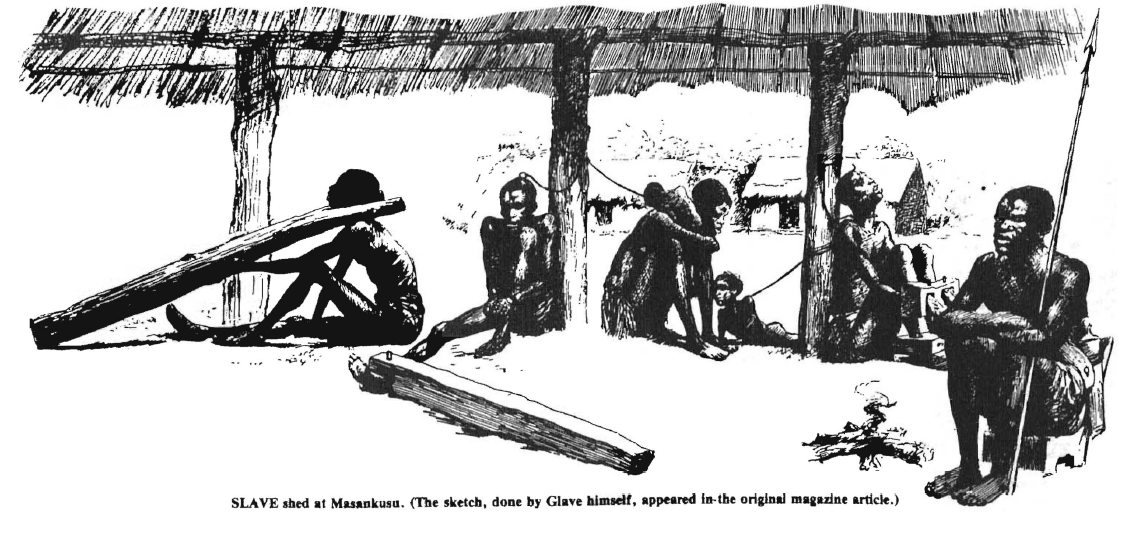
slave_shed_at_Masankusu
Slavery and cannibalism are traditional in Black Africa.
ONE OF THE PRINCIPAL ELEMENTS in the mythology of racial equality being propagated by the mass media, the schools, the churches, and numerous governmental agencies in America today is that of White responsibility for the Negro’s servile status in the past. According to the mythmakers it was the White man’s greed for the Black man’s labor which brought about the institution of Black slavery.
Prior to White encroachments into Africa south of the Sahara, beginning around the start of the 16th century, so the myth goes, Black Africans lived in a state of rustic innocence in their thatched huts, happily busying themselves with farming, handicrafts, colorful festivities, charming native customs, and so on. Then the cruel and rapacious White slave traders suddenly appeared on this blissful scene with their guns, brutally rounded up Blacks, packed them aboard slave ships, and sent them off to a life of slavery and misery in America.
“Whites didn’t start Black slavery; they stamped it out.”
That is the way the story went in the widely ballyhooed TV drama Roots, and that is about the way it goes in the newer history textbooks approved for use in the public schools. It is the “guilt” associated with this alleged enslavement of the Black race by our ancestors that Christian preachers and Federal bureaucrats alike use as a moral bludgeon to coerce a reluctant White majority in America into going along with the racial hiring and promotion quotas, the forced housing and forced busing schemes, and the thousand other racially destructive programs which characterize the policy of the ruling System.
The same myth is used to excuse the bloodiest and most savage depredations of the Black descendants of slaves against the White descendants of slaveholders today. The extraordinarily high incidence of violent Black crime in America is passed off as a manifestation of “Black rage,” justified by past and present inequities.
In the closing years of the 19th century and the early years of this century, when many of our information media were still in the hands of the Gentile majority, such a myth could not be successfully propagated. Those were also the years when Whites were first becoming acquainted with Blacks in their natural state in the interior of sub-Saharan Africa, and there was a great deal of public interest in the reports of the White missionaries and explorers who pushed beyond the coastal trading posts into the dark heart of Africa. These reports were widely published in such journals asNational Geographic, Harper’s New Monthly Magazine, and The Century Magazine.
“Full of Christian charity…”
The authors of the reports were generally men full of Christian charity and fuzzy notions of interracial brotherhood, and they were writing for a readership still under the baleful influence of the abolitionist propaganda which had brought on the fratricidal disaster of the Civil War a few decades earlier. Yet they wrote truthfully about things they saw and experienced, and the facts they reported spoke for themselves.
Those facts spoke of African slavery, not as an alien institution introduced or sustained by the White man, but as a wholly indigenous institution, as widespread and as natural among Black Africans as the building of their thatched huts, the practice of voodoo rites, or the celebration of their many festivals, and with roots just as deep. All the evidence, in fact, indicates that the Black tribes of Africa had been enslaving one another, both for food and labor, since time immemorial. It was the White man’s intervention which eventually resulted in a substantial curtailment of African slavery and cannibalism, even though these practices still persist to a certain extent in Africa today.
And African slavery, as practiced by the Blacks, was a far more brutal and cruel institution than anything perpetrated on Blacks by White slave merchants. A salient feature of the reports by White missionaries and explorers in this regard was the bloodthirsty cruelty of Blacks in their natural state, their utter disregard for any life but their own, and their total lack of any sense of compassion for suffering fellow creatures.
There is a tendency today to dismiss as wholly self-serving the earlier claims of White slaveholders who defended their ownership of Blacks on humanitarian grounds, but the stark reality of African life in its natural state supports these claims-and it also gives us a new understanding of the Black predilection for especially savage and cruel acts of violence in America today.
Let us allow the facts now to speak for themselves. Everything which follows has been excerpted from a firsthand report titled “The Slave Trade in the Congo Basin.” It was written by E.J. Glave, an associate of the noted explorer, Sir Henry M. Stanley, and it was first published in the April 1890 issue of The Century Magazine.
 *  *  *
Author and explorer E.J. Glave
“The heart of Africa is being rapidly depopulated in consequence of the enormous death toll caused by the barbarous slave-trade. It is not merely the bondage which slavery implies that should appeal to the sympathies of the civilized world; it is the bloodshed, cruelty, and misery which it involves.
“During my residence in Central Africa I was repeatedly traveling about in the villages along the Congo River and its almost unknown affluents, and in every new village I was confronted by fresh evidences of the horrible nature of this evil. I did not seek to witness the sufferings attendant upon this traffic in humanity, but cruelties of all kinds are so general that the mere passing visits which I paid brought me in constant contact with them….
“I first went to the Congo in 1883, and traveled without delay into the interior. Arriving at Stanley Pool, I received orders from my chief, Mr. Henry M. Stanley, to accompany him up river on his little boat the En Avant. Stanley at that time was engaged in establishing a few posts at important and strategic points along the upper river. Lukolela, eight hundred miles in the interior, was one decided upon, and I had the honor of being selected by him as chief of this post… Here I lived for twenty months, the only white man, so that I had every opportunity of studying native character and customs….
“At Lukolela… I had hardly settled down in my encampment when I was introduced to one of those horrible scenes of bloodshed which take place frequently in all the villages along the Congo, and which will be enacted so long as the life of a slave is counted as naught, and the spilling of his blood of as little account as that of a goat or a fowl.
“In this particular instance the mother of a chief having died, it was decided, as usual, to celebrate the evening with an execution. At the earliest streak of dawn the slow, measured beat of a big drum announces to all what is to take place, and warns the poor slave who is to be the victim that his end is nigh. It is very evident that something unusual is about to happen, and that the day is to be given up to some ceremony. The natives gather in groups and begin studiously to arrange their toilets, don their gayest loin-cloths, and ornament their legs and arms with bright metal bangles, all the time indulging in wild gesticulations and savage laughter as they discuss the coming event. Having taken a hasty meal, they produce from their houses all available musical instruments. The drums are wildly beaten as groups of men, women, and children form themselves in circles and excitedly perform dances, consisting of violent contortions of the limbs, accompanied with savage singing with repeated blasts of the war horns, each dancer trying outdo his fellow in violence of movement and strength of lung.
“Strapped to a stake…”
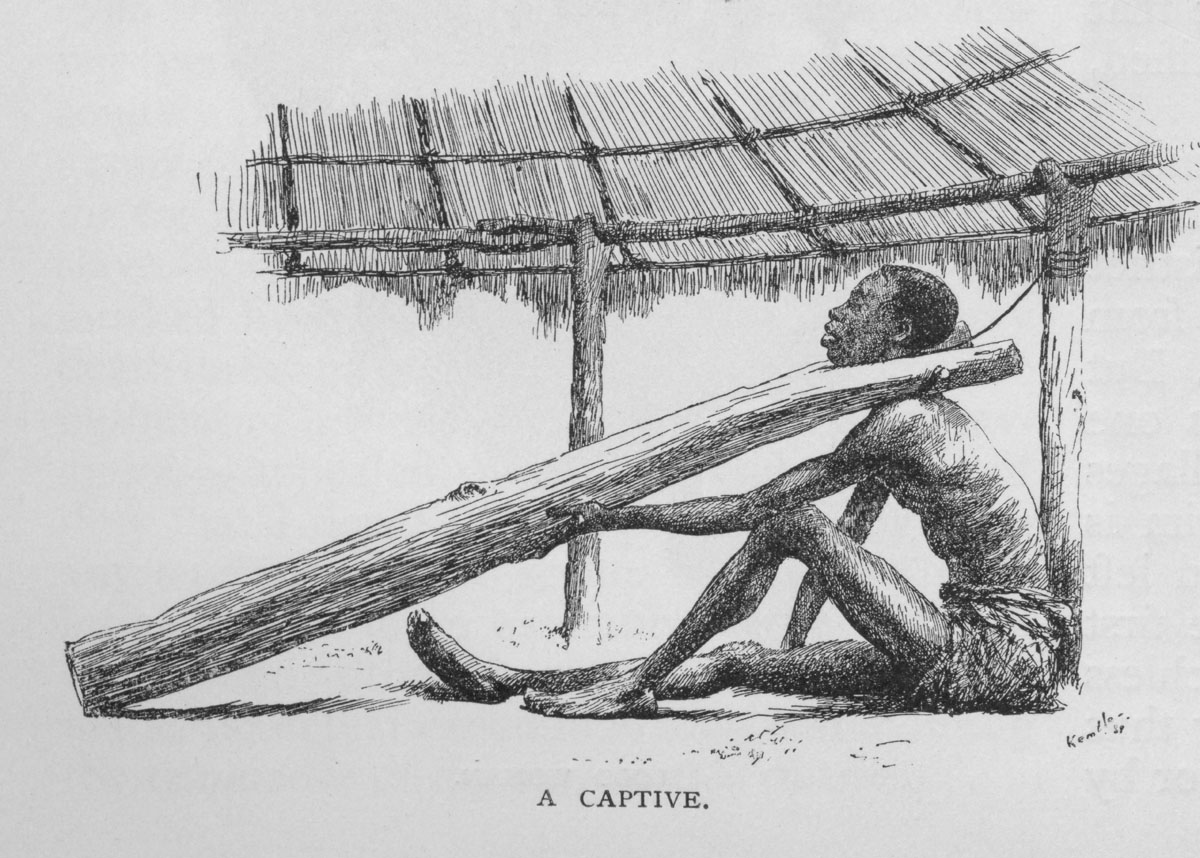
“About noon, from sheer exhaustion, combined with the heat of the sun, they are compelled to cease; then large jars of palm wine are produced, and a general bout of intoxication begins, increasing their excitement and showing up their savage nature in striking colors. The poor slave, who all this time has been lying in the corner of some hut, shackled hand and foot and closely watched, suffering the agony and suspense which this wild tumult suggests to him, is now carried to some prominent part of the village, there to be surrounded and to receive to the jeers and scoffs of the drunken mob of savages. The executioner’s assistants, having selected a suitable place for the ceremony, procure a block of wood about a foot square. The slave is then placed on this in a sitting posture; his legs are stretched out straight in front of him; the body is strapped to a stake reaching up the back to the shoulders. On each side stakes are placed under the armpits as props, to which the arms are firmly bound; other lashings are made to posts driven into the ground near the ankles and knees.
“A pole is now planted about ten feet in front of the victim, from the top of which is suspended, by a number of strings, a bamboo ring. The pole is bent over like a fishing-rod, and the ring fastened round the slave’s neck, which is kept rigid and stiff by the tension. During this preparation the dances are resumed, now rendered savage and brutal in the extreme by the drunken condition of the people. One group of dancers surround the victim and indulge in drunken mimicry of the contortions of face which the pain caused by this cruel torture forces him to show. But he has no sympathy to expect from this merciless horde.
“Presently in the distance approaches a company of two lines of young people, each holding a stem of the palm tree, so that an arch is formed between them, under which the executioner is escorted. The whole procession moves with a slow but dancing gait. Upon arriving near the doomed slave all dancing, singing, and drumming cease, and the drunken mob take their places to witness the last act of the drama.
“An unearthly silence succeeds. The executioner wears a cap composed of black cocks’ feathers; his face and neck are blackened with charcoal, except the eyes, the lids of which are painted with white chalk. The hands and arms to the elbow, and feet and legs to the knee, are also blackened. His legs are adorned profusely with broad metal anklets, and around his waist are strung wild-cat skins. As he performs a wild dance around his victim, every now and then making a feint with his knife, a murmur of admiration arises from the assembled crowd. He then approaches and makes a thin chalk mark on the neck of the fated man. After two or three passes of the knife, to get the right swing, he delivers the fated blow, and with one stroke of his keen-edged weapon severs the head from the body.
“The sight of the blood brings to a climax the frenzy of the natives; some of them savagely puncture the quivering trunk with their spears, others hack at it with their knives, while the remainder engage in a ghastly struggle for the possession of the head, which has been jerked into the air by the released tension of the sapling. As each man obtains the trophy, and is pursued by the drunken rabble, the hideous tumult becomes deafening; they smear one another’s faces with blood, and fights always spring up as a result, when knives and spears are freely used….
“When the taste for blood has been to a certain extent satisfied, they again resume their singing and dancing while another victim is prepared, when the same ghastly exhibition is repeated. Sometimes as many as twenty slaves will be slaughtered in one day. The dancing and general drunken uproar is continued until midnight, when once more absolute silence ensues, in utter contrast to the hideous tumult of the day.
“I had frequently heard the natives boast of the skill of their executioners, but I doubted their ability to decapitate a man with one blow of the soft metal knives they use. I imagined they would be compelled to hack the head from the body. When I witnessed this sickening spectacle I was alone, unarmed, and absolutely powerless to interfere. But the mute agony of this poor black martyr, who was to die for no crime, but simply because he was a slave — whose every piteous movement was mocked by frenzied savages, and whose very death throes gave the signal for the unrestrained outburst of a hideous carnival of drunken savagery — appealed so strongly to my sense of duty that I decided upon preventing by force any repetition of this scene…
“All tribes I have known have an idea of immortality. They believe that death leads but to another life, to be continued under the same conditions as the life they are now leading; and a chief thinks that if when he enters into this new existence he is accompanied by a sufficient following of slaves he will be entitled to the same rank in the next world as he holds in this. From this belief emanates one of their most barbarous customs — the ceremony of human sacrifices upon the death of any one of importance. Upon the decease of a chief, a certain number of his slaves are selected to be sacrificed, that their spirits may accompany him to the next world. Should this chief possess thirty men and twenty women, seven or eight of the former and six or seven of the latter will suffer death. The men are decapitated, and the women are strangled. When a woman is sacrificed she is adorned with bright metal bangles, her toilet is carefully attended to, her hair is neatly plaited, and bright-colored cloths are wrapped around her. Her hands are then pinioned behind, and her neck is passed through a noose of cord; the long end of the cord is led over the branch of the nearest tree, and is drawn taut at a given signal; and while the body is swinging in mid-air its convulsive movements are imitated with savage gusto by the spectators. It often happens that a little child also becomes a victim to this horrible ceremony, by being placed in the grave alive, as a pillow for the dead chief. These executions are still perpetrated in all the villages of the Upper Congo.
“But the life of the slave is not only forfeited at the death of the chief of the tribe in which fate has cast his lot. Let us supposed that the tribe he is owned by has been maintaining an internecine warfare with another tribe in the same district. For some reason it is deemed politic by the chief to bring the feud to an end, and a meeting is arranged with his rival. At the conclusion of the interview, in order that the treaty of peace may be solemnly ratified, blood must be spilled.
“Buried alive with only the head left above the ground…”
“A slave is therefore selected, and the mode of torture preceding his death will vary in different districts. In the Ubangi River district the slave is suspended head downwards from the branch of a tree, and there left to die. But even more horrible is the fate of such a one at Chumbiri, Bolobo, or the large villages around Irebu, where the expiatory victim is actually buried alive with only the head left above the ground. All his bones have first been crushed or broken, and in speechless agony he waits for death….
“[The Lolo] villages are constantly attacked by the powerful roving tribes of the Lufembe and Ngombe. These two tribes are voracious cannibals. They surround the Lolo villages at night, and at the first signs of dawn pounce down upon the unsuspecting Balolo, killing all the men who resist and catching all the rest. They then select the stronger portion of their captives, and shackle them hand and foot to prevent their escape. The remainder they kill, distributing the flesh among themselves. As a rule, after such a raid they form a small encampment; they light their fires, seize all the bananas in the village, and gorge upon the human flesh. They then march over to one of the numerous slave markets on the river, where they exchange the captives with the slave-traders of the Lulungu River for beads, cloth, brass wire, and other trinkets. The slave-traders pack the slaves into their canoes and take them down to the villages on the Lulungu River where the more important markets are held. Masankusu, situated at the junction of the Lupuri and Malinga tributaries, is by far the most important slave-trading center. The people of Masankusu buy their slaves from the Lufembe and Ngombe raiders, and sell them to the Lulungu natives and traders from down river. The slaves are exhibited for sale at Masankusu in long sheds, or rather under simple grass roofs supported on long poles. It is heartrending to see the inmates of one of these slave-sheds….
A captive
A captive
“They are hobbled with roughly hewn logs which chafe their limbs to open sores; sometimes a whole tree presses its weight on their bodies while their necks are penned into the natural prong formed by its branching limbs. Others sit from day to day with their legs and arms maintained in a fixed position by rudely constructed stocks, and each slave is secured to the roof-posts by a cord knotted to a cane ring which either encircles his neck or is intertwined with his woolly hair. Many die of pure starvation, as the owners give them barely enough food to exist upon, and even that they grudge them. These hungry creatures form indeed a truly pitiable sight. After suffering this captivity for a short time they become mere skeletons. All ages, of both sexes, are to be seen; mothers with their babes; young men and women; boys and girls; and even babies who cannot yet walk, and whose mothers have died of starvation, or perhaps been killed by the Lufembe. One seldom sees either old men or old women; they are all killed in the raids; their marketable value being very small, no trouble is taken with them….
A slave shed
A slave shed
“There were certainly five hundred slaves exposed for sale in this one village alone. Large canoes were constantly arriving from down river, with merchandise of all kinds with which they purchased these slaves. A large trade is carried on between the Ubangi and Lulungu rivers. The people inhabiting the mouth of the Ubangi buy the Balolo slaves at Masankusu and the other markets. They then take them up the Ubangi River and exchange them with the natives there for ivory. These natives buy their slaves solely for food. Having purchased slaves they feed them on ripe bananas, fish, and oil, and when they get them into good conditions they kill them. Hundreds of the Balolo slaves are taken into the river and disposed of in this way each month. A great many other slaves are sold to the large villages on the Congo, to supply victims for the execution ceremonies.
Left to starve
“Much life is lost in the capturing of slaves, and during their captivity many succumb to starvation. Of the remainder, numbers are sold to become victims to cannibalism and human sacrifice ceremonies. There are few indeed who are allowed to live and prosper.
“Cannibalism exists among all the peoples on the Upper Congo east of 16 E. longitude, and is prevalent to an even greater extent among the people inhabiting the banks of the numerous affluents. During a two-months’ voyage on the Ubangi River I was constantly brought into contact with cannibalism. The natives there pride themselves upon the number of skulls they possess, denoting the number of victims they have been able to obtain. I saw one native hut, around which was built a raised platform of clay a foot wide, on which were placed rows of human skulls, forming a ghastly picture, but one of which the chief was very proud, as he signified by the admiring way he drew my attention to the sight. Bunches of twenty and thirty skulls were hung about in prominent positions in the village. I asked one young chief, who was certainly not more than twenty-five years old, how many men he had eaten in his village, and he answered me thirty. He was greatly astonished at the horror I expressed at his answer. In one village again, as I had bought a tusk of ivory, the natives thought perhaps I might buy skulls, and several armfuls were brought down to my boat within a few minutes….
“During my first visit to the upper waters of the Malinga River cannibalism was brought to my notice in a ghastly manner. One night I heard a woman’s piercing shriek, followed by a stifled, gurgling moan; then boisterous laughter, when all again became silent. In the morning I was horrified to see a native offering for sale to my men a piece of human flesh, the skin of which bore the tribal tattoo mark of the Balolo. I afterwards learned that the cry we had heard at night was from a female slave whose throat had been cut. I was absent from this village of Malinga for ten days. On my return I inquired if any further bloodshed had taken place, and was informed that five other women had been killed.
“While in the Ruki River at the beginning of this year, I was furnished with another proof of the horrible fate of the slaves. At Esenge, a village near which I stopped to cut wood for my steamer, I heard ominous beating of drums and outbreaks of excited mirth. I was informed by one of the natives from the village that an execution was taking place. To my inquiry whether they were in the habit of eating human flesh, he replied, ‘We eat the body entirely.’ I further asked what they did with the head. ‘Eat it,’ he replied; ‘but first we put it in the fire to singe the hair off.’…”
*  *  *
Thus, the Black man in his natural environment — not observed at some awkward moment, during a time of turmoil, when the worst in him may have been temporarily brought out, but just as he had been for countless thousands of years before the arrival of the first White man. Only fools can believe that any fundamental change has taken place in his nature during the last 90 years.
From National Vanguard No. 75, 1980
transcribed by Vanessa Neubauer from the book The Best of Attack! and National Vanguard, edited by Kevin Alfred Strom http://nationalvanguard.org/2013/11/the-roots-of-black-slavery/