Monday, November 4, 2013

Our Cause


Our Cause

Text of 1976 speech by Dr. William L. Pierce to his supporters:

EVERY DAY, I receive letters from our members across the country as well as from people here in the Washington area who have attended our meetings in the past. These letters and questions indicate that there is still some uncertainty in people’s minds as to what we are, what we believe, and what we intend to do. Questions, in other words, as to what it’s all about. I want to try again tonight to answer these questions as clearly as I possibly can.
I’m sure that one of the difficulties people have in trying to understand us is that they can’t figure out quite how to categorize us. They’re accustomed to putting everything they encounter in life into little, mental pigeonholes labeled right-wing, left-wing, communist, racist, and so on. And once they’ve done that, they think they understand the thing.
Now the trouble is that we don’t quite fit any of the customary pigeonholes. And that is because the doctrine of the National Alliance, the truth for which we stand, is not just a rehash of old and familiar ideas but is really something new to Americans.
Perhaps the best way to approach an understanding of the Alliance is to start by getting rid of some of the most troublesome pigeonholes altogether. That is, by pointing out what we are not. We are not, as many people tend to assume at first, either a conservative or a right-wing group. And I’m not just trying to be cute when I say that. I’m not just trying to emphasize that we are a special right-wing group or a better right-wing group. In fact, our truth has very little in common with most right-wing creeds. We’re not interested, for example, in restoring the Constitution. The Constitution, written 200 years ago, served a certain purpose well for a time. But that time is now passed. Nor was its purpose the same as our purpose today. We’re not interested in states’ rights, in restoring the former sovereignty of the individual states. We do not believe, as our conservative friends do, that a strong and centralized government is an evil in itself. It is, in fact, a necessity in overcoming many of the obstacles which lie ahead of us as a people.
What else is dear to the hearts of right-wingers? Do we want to restore prayer and Bible reading to the public schools? Hardly. Anti-fluoridation? Nonsense. Income tax? Abortion? Pornography? Well, we may sympathize more with the right-wing position on these issues than we do with the left-wing position, but they are still only peripheral issues for us. They are not the reason why we are here. They are not the things we are prepared to die for.
There are, in fact, several issues on which we are closer to what would ordinarily be considered the left-wing or liberal position than we are to the conservative or right-wing position. One of these issues is the ecology issue: the protection of our natural environment, the elimination of pollution, and the protection of wildlife. And there are also other issues in which we are closer to the liberals than to the conservatives, although I doubt that we agree with them completely on any issue; just as we seldom, if ever, agree completely with the right-wing on any issue.
The reason for the lack of complete agreement, when there seems to be approximate agreement, with either the right or the left is that our position on every issue is derived from an underlying view of the world which is fundamentally different from those of either the right or the left. That is, to the extent that they have any underlying philosophy at all. Often there is none, and a great many people who identify themselves as liberals, conservatives, or moderates simply have an assortment of views on various issues which are not related to any common idea, purpose, or philosophy.
Before we turn to a positive look at the Alliance, let me inject just a few more negatives. One thing we are not trying to do is to find any quick or easy solutions to the problems confronting us as a people. We have enormously difficult problems. If we are to solve them at all, we must tackle them with more determination, more tenacity, and more fanaticism than they have ever been tackled before. We must prepare ourselves mentally and spiritually for a very long, bloody, and agonizing struggle.
We mustn’t imagine that we are like a squad of soldiers about to assault a cave full of robbers and that the only preparation we need is to be sure our bayonets are fixed and that our powder is dry. This seems to be the attitude of most patriots these days and it is not a realistic one. “Throw out those bums in Washington,” they say, “and our problems will be over.”
No. We must think of ourselves instead as the beginning — the barest beginning — of a mighty army whose task is not to clean out a cave full of robbers, but is to conquer an entire hostile world. Before the first shot is fired we must build our invasion fleet with thousands of ships and siege engines. We must lay in massive supplies of cannon balls, powder, and all sorts of other munitions. And we must do a hundred other things.
In other words, we must prepare ourselves for our political struggle before we can count on it yielding anything other than the invariable failure which has rewarded patriots in the past. We must build a foundation which will sustain us for a very long campaign.
Let me give you another analogy. We are like a tribe of hungry, starving people living in a land which, although the soil is fertile, provides relatively little to eat. These people find a few berries growing on bushes and a few edible roots in the ground. All they can think about is that they are hungry and they must fill their bellies. This is their immediate problem. They spend all of their time, day after day, year after year, hunting for those scarce berries on the bushes and pulling an occasional edible root out of the ground. And they never really fill their bellies; they always remain hungry and on the edge of starvation. That is because no one has ever taken a few minutes off from berry hunting and thought further ahead than the immediate problem of filling his belly, now, for this meal. No one has proposed that while some continue to hunt for berries, others in the tribe should tolerate their hunger pains for a while and make themselves a few simple tools, a simple plow from a tree branch perhaps, and a hoe, and then use these tools to plow up some of the most fertile areas of their land and plant a few berries in furrows and keep watch over them so that the birds don’t scratch them up. They could weed their furrows and perhaps divert a portion of a nearby stream for irrigation. If they did this, if they thought beyond their immediate problem, and, to the extent possible, tackled a much larger problem, they would eventually, even though it might take years, solve the problem of hunger which they could never solve when that was all they thought about. The solution to the problem of keeping their bellies full would be to develop an agricultural basis for their berry-picking and root-digging.
Now we need a philosophical and spiritual basis for our political struggle. A basis, of course, which tells us why we must fight and what we are fighting for. But we also want a basis which will tell us how to build a whole new world after we have won the political struggle. In other words, we are not building a basis to use for a month, or for a few years, but a basis which will last a thousand years and more. We are building a basis which will serve not only us, but also countless future generation of our race. And it is high time that we did this. We have drifted without any sense of direction, without any long-range perspectives, for far too long. It’s time that we stopped fixing our sights on next year, or the next election, and fix them instead on eternity.
You know, we Americans are famous for being a practical people, a hard-headed, no nonsense people. We are not great thinkers, perhaps, but we are real problem solvers. We don’t fool around; we plow right into things. That’s how we settled this country. We didn’t agonize about whether we were being fair to the Indians when we took their land; we just walked right over them and kept moving west. That’s what we had to do. We just followed our instincts and used our heads and, more often than not, we did the right thing.
But we also made some mistakes, bad mistakes. Because the southern colonies were ideally suited for certain types of crops which required lots of hand labor, there weren’t any machines back then of course, we brought Negroes into the country. That seemed to make pretty good economic sense at the time. But we really should have thought harder about the long-range consequences of that move. We wouldn’t have had to be real wizards to foresee the future. History provides a number of instructive examples for us to study.
We kept on making mistakes: mistakes based on shortsightedness mostly, mistakes from not being able to give any real weight to anything but the immediate problem, mistakes from not thinking far enough ahead. Analyzing the situation a little more deeply, we can say that we were shortsighted because we had no really firm basis for being longsighted. We had no solid foundation on which to stand in order to evaluate the long-range consequences of our decisions. And, as a result of this, we were suckers for various brands of sentimentality, strictly here and now sentimentality, sentimentality rooted only in the present. It was this sort of fuzzy sentimentality, this Uncle Tom’s Cabin sentimentality, which led to the war between the states and to the dumping of some three million Blacks into our free society a hundred years ago. It also led to our failure to properly control immigration into this country, our failure to prevent the flood of Jews which poured in after the Civil War.
These things troubled many good people. Lincoln was troubled over the potential consequences of freeing the Negroes. Later, others were troubled over the dangers of uncontrolled immigration. But the fuzzy sentimentalists prevailed because those who knew in their hearts that the country was making mistakes didn’t have a really solid basis from which to oppose the sentimentalists. They didn’t have their sights fixed on eternity. They had no all-encompassing worldview to back them up.
And the same problem of shortsightedness is far worse today. A person goes to church and hears his minister tell him that we are all God’s children, Black and White. And although his instinct tries to tell him that the minister is leading him astray, he will not challenge the minister because he has no firm convictions rooted in eternity to back up his feelings. The same is true of the whole country, and of our whole race, today. We are like a ship without a compass. Various factions of the crew are arguing about which way to steer, but no one really knows where the ship is headed. We’ve lost our sense of direction. We no longer have a distant, fixed star to guide us. Actually, it’s even worse than that. We have lost our ability to follow a distant star even if we could see one. We are like a nation, like a race, without a soul. And that is a fatal condition.
No purely political program can have any real value for us in the long run unless we get our souls back, unless we learn once again how to be true to our inner nature, unless we learn to heed the divine spark inside us and base all our decisions on a clear and comprehensive philosophy illuminated by that spark.
Let me tell you a little story, which I believe illustrates our problem. Several years ago, I spoke to a class at a private high school in Maryland. It was the Indian Spring Friends’ School operated by the Quakers, but with a student body which seemed to be about equally divided between Jews and gentiles, with a few token Blacks thrown in. Throughout my talk to the class, a blond girl and the only Negro in the class were sitting next to each other in the front row and kissing and fondling each other in an obviously planned effort to distract me. The subject of my talk was the importance of White Americans developing a sense of racial identity and racial pride if we are to survive. When I finished, a White student, about 17-years-old, rose to ask the first question. His question was, “What makes you think it’s so important for the White race to survive?”
I was flabbergasted and at a loss for words. And while I stood there with my mouth open, a young Jew popped up and gave his own answer. “There is no good reason at all for Whites to survive,” the Jew announced, “because they have contributed nothing to the human race except the knowledge of how to kill people. Other races have contributed everything worthwhile, everything which allows people to be happier and more comfortable.” And then he rattled off a list of five or six names: Freud, Einstein, Salk, and a few others — all Jews. I then asked him if he himself were a Jew and he replied with as much arrogance and contempt as he could muster, “Yes I am and proud of it!” At this point the whole class, Whites included, rose and gave the young Jew a standing ovation. The teacher at the back of the room had a big grin on his face.
Needless to say, my talk was pretty well wasted on that class. The White kids in there had been subjected to so much moral intimidation, they had been pumped so full of racial guilt and self-hatred, their minds were so twisted, that it’s doubtful whether anyone could straighten them out. Certainly no one could in an hour’s time.
But the thing which bothered me even more than the phony collective racial guilt which had been pumped into those boys and girls, was my inability to answer the White kid’s question. Why should we survive? That’s one of those questions like, why is good better than evil? Or, nowadays, why is heterosexuality any better than homosexuality? If two people want to have sex together, who are we to say that it’s better that they be a man and a woman than that they be two men or two women? A related question concerns racial mixing: why shouldn’t a Black man and a White woman, or vice versa, live together if they can be happy? These are questions which most White people, even normal healthy White people, cannot answer satisfactorily today.
A hundred years ago, before the Jews came flooding into our country and taking over our mass media and our educational system, we might not have really needed answers. We just knew that it was important for our race to survive and to make progress. We knew that homosexuality and interracial sex were wrong. Our intuition told us this. The answers were in our souls even if we couldn’t express them in words. But then the Jews — who are clever people, very clever people — came along, and they began asking these very questions. And when we couldn’t answer them, they began providing their own answers.
Now all of us here tonight know what the Jews’ answers are. We read them in our newspapers and hear them on television every day. Some White people, in fact a majority at first, did oppose the Jews’ plans. But their reasons for opposing them were all the wrong ones. For example, when asked “Why shouldn’t your son or daughter marry a Black?” their answer was “Well, two people with such different backgrounds won’t be happy together. They will have children of mixed race who won’t be accepted by either Whites or Blacks. There’s a better chance for a marriage to work out if both partners are of the same race. The world just isn’t ready for inter-marriage yet.” Well, of course, the Jews made pretty short work of such shallow and superficial objections. The problem was that our people had already accepted most of the basic Jewish premises. Our criterion for choosing a marriage partner was happiness — happiness! –either ours or our children’s. No one had any really solid answers, answers based on something fundamental. Certainly the churches, whose role should have been to provide the right answers, were of no help. They in fact were, and are, in the forefront of the Jewish assault on all our values and institutions. They are so much in hock to the Jews that they are busy now trying to figure out how they can rewrite the New Testament, removing or changing all the parts that Jews consider offensive, such as the Jewish responsibility for the crucifixion of Jesus.
The Jews were able to continue hammering away at White Americans — probing, prying, asking more questions, raising more doubts — until we had lost all faith in what we had earlier known intuitively was right. Our ethics, our code of behavior, our values, our feelings, and our aspirations all went down the drain. What they gave us instead was the new “morality” of ‘if it feels good, do it.’ Our children are taught in school that progress means more happiness for more people. And happiness, of course, means feeling good. The whole thing is summed up in a Coca-Cola commercial. I’m sure you have all seen it on TV: a ring of twenty people or so, of all colors and both sexes, obviously as happy and care-free as they could possibly be, are all holding hands and singing, “I’d like to give the world a Coke.” Now who but the meanest and most narrow-minded racist is going to criticize something like that?
The average American — even one who does not approve of racial mixing — doesn’t know how to respond to a clever appeal like the Coca-Cola commercial, certainly the average White kid in our schools today doesn’t. And once he has unconsciously accepted the hidden premises in that commercial — and the entire attitude toward life from which it is sprung — the question I was asked at the Indian Spring Friends’ School naturally follows. Since people of all races are equal and essentially the same — Whites, Negroes, Jews, Gypsies, Chinamen, Mulattoes — and since they can all be happy doing the same sorts of things, why should we worry about what a person’s race is, or even about our own? Wouldn’t sex be just as pleasurable for us if we were Black instead of White? Wouldn’t a Coke taste just as good? What difference does it make if our grandchildren are Mulattoes so long as the economy is still strong and they can all afford nice cars and 25-inch color TV sets?
Now, one can attack this Jewish fantasy world with facts. One can point out that although Jews are clever, they haven’t done everything worthwhile in the world. White people have done a few things besides kill other people. And one can point out that racial differences are more than skin deep. One can talk about IQ scores; one can cite historical examples in which civilization after civilization has declined and crumbled when the race that built that civilization began intermarrying with its slaves. But none of that is really going to convince the kid whose main concern is whether the consumers of the world — whether the happy Coke drinkers — will be any less happy in a world without Whites.
What we failed to do in the past was to understand the deep inner source from which our feelings and intuition about race and other matters sprang. We had no really sound and healthy worldview to offer that White kid in place of the slick, plastic, Jewish worldview of the Coca-Cola commercial. And so we couldn’t really answer his question about the survival of the White race any more than we could give him a really convincing reason about why he shouldn’t do just anything that feels good — whether it is taking dope, or sleeping with Blacks, or experimenting with homosexuality.
You may think of that kid as an extreme liberal case, but he is really no different than the average — and I mean the average — businessman in this country. He used to be a segregationist a few years ago, but he became an integrationist when the Blacks started rioting and burning things in the late 1960′s. After all, riots are bad for business. Their individual views of the world may be a little different, but the businessman and the kid in Maryland both base their thinking on one and the same thing — egoistic Jewish materialism. The kid who believes that the purpose of life is happiness, knows that there are not many things on this earth happier than a bunch of pickaninnies splashing in a mud puddle. And the businessman who believes that the purpose of life is to make money knows that a Black customer’s money is just as green as a White customer’s.
A person who accepts that sort of basis, indeed, cannot see any really convincing reason why the White race should survive. His aim is to live a “good life.” And for him that means a life with lots of money, lots to eat and drink, plenty of sex, new cars, big houses, and constant diversions. Entertainment: that is all he lives for, all he cares about, and all he understands. Talk about purpose to him and his eyes go blank. Talk about eternity and he laughs at you. He knows that he won’t live forever, although he doesn’t like to think about that. He intends to get as much out of life as he can. Anything beyond that means nothing to him. What a difference that is from the attitude toward life that our ancestors in northern Europe had a few hundred years ago. They were greedy for money like we are, of course, and they liked to enjoy themselves when they could, but that was not the meaning of life for them. Their attitude toward life and death was perhaps best summed up in a stanza from one of the old Norse sagas. It goes like this:
Kinsmen die and cattle die,
And so must one die one’s self,
But there is one thing I know which never dies
And that is the fame of a dead man’s deeds.
The German philosopher Arthur Shopenhauer expressed essentially the same idea when he said that the very most any man can hope for is a heroic passage through life. Greatness, in other words, instead of happiness, is the mark of a good life. Now I don’t mean to suggest that we must all think in terms of becoming famous or of dying heroically on the battlefield with sword or gun in hand. Some of us may be granted that, but what is important, what all of us can do, even those who think of ourselves as basically unheroic, is to adopt the attitude toward life and toward death which was implicit in the old sagas and in Shopenhauer’s statement.
The attitude of living for the sake of eternity, of living with eternity always in mind instead of living only for the moment; the attitude that the individual is not an end in himself, but rather that the individual lives for and through something greater — in particular, for and through his racial community (which is eternal) — seems to have eluded most of us today. It is an attitude which is diametrically opposed to the Jewish attitude of egoism and materialism. And yet it is the alien Jewish attitude that has been adopted by most Americans today. We have chosen happiness instead of greatness, the moment instead of eternity. We have become a nation — a whole race — of full-time self-seekers, a race concerned with one thing: self-gratification.
The average man, of course, has always been pretty shortsighted and his interests have always pretty much been limited to his own welfare. So the materialism of today that I’ve been talking about is a matter of degree. It has a somewhat stronger grip on the man in the street than it formerly did. But what is worse is that today it also has a grip on our leaders, on our teachers, on our poets, on our philosophers, and even on our priests. It has so thoroughly saturated the souls of all of us that we have reacted to it by becoming spiritually ill. And this spiritual sickness, this loss of our souls, is why we are in such a mess today. And it is why we will be in a worse and worse mess as time goes on. We will never overcome the problems facing us until it is cured.
And please do not misunderstand me. I am not talking about the “wages of sin” in the sense with which many of us may be familiar. I’m not talking about some anthropomorphic deity, some heavenly father sitting on his throne in the sky punishing us, keeping us from overcoming our enemies because we are not fulfilling his commandments. No, that’s nonsense! We are not being punished by any supernatural being. We are in trouble for the same reason that an explorer in a harsh and trackless wilderness is in trouble when he loses his compass and cannot see the sky through the dense foliage. He no longer knows which way to go. That is our most fundamental problem — we do not know where we are going. We have no sense of direction. We have stumbled off the path.
But that is something I really should not have had to tell you because everyone here today knows this. Even if he doesn’t understand yet how or why he knows it. He still knows that the present course our society has taken is wrong. It is unnatural. It is evil. We all know that it is wrong to accept the “I’m all right, Jack” attitude which prevails today. We know that it’s wrong to live only for the present, to forget the past and to ignore the future. It is wrong to have instant self-gratification as our only goal. That’s why we are here. We know that there is something more, something else, a better way. We know this for the same reason we are attracted to beauty and to nobility and are repelled by the ugly and the base, regardless of the artificial fashions of our day. We know it because deep inside all of us, in our race-soul, there is a source of divine wisdom, of ages-old wisdom, of wisdom as old as the universe. That is the wisdom, the truth, which we in the National Alliance want to make the basis of our national policy. It is a truth of which most of us have been largely unconscious all our lives, but which now we have the opportunity to understand clearly and precisely.
Our truth tells us that no man, no race, not even this planet, exists as an end in itself. The only thing which exists as an end in its self is the whole. The whole of which the things I just named are parts. The universe is the physical manifestation of the whole. The whole is continually changing and always will be. It is evolving. That is, it is moving toward ever more complex, ever higher, states of existence. The development of life on earth from non-living matter was one step in this never-ending evolutionary process. The evolution of man-like creatures from more primitive forms of life was another step. The diversification of these creatures into the various races and sub-races, and the continued evolution of these different races in different parts of the world at different rates, have been continuations of this process. The entire evolution of life on earth from its beginning some three billion years ago, and in a more general sense, the evolution of the universe over a much longer period before the appearance of life, is an evolution not only in the sense of yielding more and more highly developed physical forms, but also an evolution in consciousness. It is an evolution in the self-consciousness of the whole.
From the beginning, the whole, the creator, the self-created, has followed, has in fact embodied, an upward urge — an urge toward higher and higher degrees of self-consciousness, toward ever more nearly perfect states of self-realization.
In man — in our race in particular — this upward urge, this divine spark, has brought us to a new threshold. A threshold as important as that which separated the non-living matter of three billion years ago from the living matter into which it evolved. Today’s threshold is a threshold in self-consciousness. We stand now on the verge of a full understanding of the fact that we are a manifestation of the creator, that we are the means and the substance by which the creator, by which the whole of which we are a part, can continue its self-evolution.
When we understand this, when we heed the divine spark within us, then we can once again ascend the upward path that has led us from sub-man to man and can lead us now from man to super-man and beyond. But we cannot do this, we cannot find the path, without this consciousness, without this understanding that the responsibility is ours, that we are not the playthings of God but are ourselves a manifestation of God and can become, must become, now a consciousmanifestation. Only in that way can we fulfill our ordained destiny.
Let me emphasize again, in different words, what I told you earlier this evening about building a spiritual basis for our political work. The Alliance’s long-range approach is necessary, absolutely necessary, and unavoidable. The short-range approaches that other patriots are trying, and have been trying for many decades now, the thousands of ad hoc solutions of quick and easy one-issue approaches, whether of tax-rebellion or of bomb throwing, cannot solve the ultimate problems with which we are faced. They cannot give us back our souls. It may seem ironical that we should be trying to conquer and transform the whole world, that we should be planning for eternity, when no one else has been able to make a successful plan for achieving very much more limited goals, restoring the constitution, for example, or getting us out of the United Nations, or what have you. But it is the very shortsightedness of those working for these limited goals which has been the cause of their failure. And it is our rooting of our plans in eternity which gives us confidence for their ultimate success no matter how long it may take us.
So I tell you again, our approach is not just a matter of choice; it is necessary. There is no other way but ours. There is only one path. And there is something else we must understand. Our philosophy, our quest for the upward path, is not something that we should accept reluctantly because we see it as necessary to the solution of our race problem, our Jewish problem, and our communist problem. It is not something we accept because we cannot find an easier approach to these problems. No! If we look at it that way then we still haven’t rid ourselves of the shortsightedness that has been our curse in the past. We must understand that the truth for which we stand transcends all the problems of the present. Finding our way once again to the one true path transcends all questions of economics, of politics, and ultimately even of race, just as eternity transcends tomorrow. So let’s stop putting the cart before the horse mentally and spiritually. Let’s take off our mental blinders. Let’s realize that the truth has a value in itself and that dedication to the truth is a virtue in itself. This is all the more true in a world in which falsehood seems to rule.
The problems with which we are faced in the world today are serious ones and they must be solved. But the first and most important task, the task on which all our other problems must eventually depend for their solutions, but also the task which would still be just as important for us to accomplish if all our other problems didn’t exist, is the task, the one task, assigned to us by the creator. That is the task of achieving full consciousness of our oneness with the whole, achieving full consciousness that we are a part of the creator and that our destiny is to achieve the single purpose for which the universe exists — the self-realization of the creator.
Our truth is a very simple truth, but its implications are enormous beyond imagining. To the extent that we understand and accept it, it sets us apart from all the people around us. Our acceptance of this truth marks us as the only adults in a world of children. For implicit in what we believe is our recognition and acceptance of our responsibility for the future of the universe. The fate of everything that will ever be rests in our hands now. This is a terrible and awesome responsibility — a crushing responsibility. If we were only men we could not bear it. We would have to invent some supernatural being to foist our responsibility onto. But we must, and can, bear it when we understand that we ourselves embody the divine spark which is the upward driving urge of the universe.
The acceptance of our truth not only burdens us with the responsibility that other men have shunned throughout history, it bestows on us a mantle of moral authority that goes along with the responsibility, the moral authority to do whatever is necessary in carrying out our responsibility. Furthermore, it is an acceptance of our destiny, an unlimited destiny, a destiny glorious beyond imagination, if we truly have the courage of our convictions. If we truly abide by the demands that our truth places upon us, it means that while other men continue to live only for the day, continue to seek only self-gratification, and continue to live lives which are essentially without meaning and that leave no trace behind them when they are over, we are living and working for the sake of eternity. In so doing, we are becoming a part of that eternity.
For some, our task may seem too great for us, our responsibility too overwhelming. If they are correct, if we choose to remain children instead of accepting our adulthood, if we continue the shortsighted approaches of the past, then in the long run we will fail utterly. The enemies of our race will prevail over us and we and our kind will pass away forever. All our sacrifices, and all the dreams and sacrifices of our ancestors, will have been in vain. Not even a memory of us, or our kind, will be left when the creative spirit of the universe tries, in some other place, in some other time, in some other way, to do what we failed to do. But I do not believe that we will fail. Because in working to achieve our purpose, we are finding our way once again to the right and natural path for our people. We are working once again with the whole. And we have a mighty tradition behind us.
Our purpose is the purpose for which the earth was born out of the gas and the dust of the cosmos, the purpose for which the first primitive amphibian crawled out of the sea three hundred million years ago and learned to live on the land, the purpose for which the first race of men held themselves apart from the races of sub-men around them and bred only with their own kind. It is the purpose for which men first captured lightning from the sky, tamed it, and called it fire; the purpose for which our ancestors built the world’s first astronomical observatory on a British plain more than 4,000 years ago. It is the purpose for which Jesus, the Galilean, fought the Jews and died 2,000 years ago; the purpose for which Rembrandt painted; the purpose for which Shakespeare wrote; and the purpose for which Newton pondered. Our purpose, the purpose with which we must become obsessed, is that for which the best, the noblest, men and women of our race down through the ages have struggled and died whether they were fully conscious of it or not. It is the purpose for which they sought beauty and created beauty; the purpose for which they studied the heavens and taught themselves Nature’s mysteries; the purpose for which they fought the degenerative, the regressive, and the evil forces all around them; the purpose for which, instead of taking the easy path in life, the downward path; they chose the upward path, regardless of the pain, suffering, and sacrifice that this choice entailed.
Yes! They did these things, largely without having a full understanding of why, just as the first amphibian did not understand his purpose when he crawled onto the land. Our purpose is the creator’s purpose, our path is the path of divine consciousness, the path of the creator’s self-realization. This is the path which is ordained for us because of what we are, because of the spark of divine consciousness in us, and in no one else. No other race can travel this path, our path, for us. We alone must prove whether we are fit to serve the creator’s purpose. And if we are fit, if we once again heed the inner knowledge engraved in our souls by the creator, if we regain faith in the things we once knew were true without fully understanding why and if we now also teach ourselves why, then we will once again be on the upward path ordained for us, and our destiny will be godhood.
Those of you who are with us for the first time have, I hope, gained at least the beginning of an understanding of who we are and of what we want to do. I know that I have left many of your questions unanswered; questions about current political, social, racial, and economic issues; questions about concrete things. We do talk about those things in our meetings. We talk about them in a very concrete and down-to-earth fashion. I’ve discussed them in past meetings and I’ll discuss them again in future ones — the goals of overcoming the enemies of our people, of safeguarding the future of our race, and of building a new order of beauty, sanity, strength, and health on this earth, so that our people can progress and mature until they are capable of fulfilling the role allotted to them by the creator. But now I want to be sure that you understand just one thing. If we ever are to achieve these concrete advances, these physical victories, this material renewal of our nation, of our civilization, of our race, then we must first make the spiritual advances that I’ve talked about here. Without the spiritual basis, the material victory will not be achieved.
As I said, in our future meetings we will explore many individual issues in much greater detail than we have here. We hope you will join us in these future meetings and further increase your understanding of our work, and we hope that you will begin to share our commitment to this work. And let me say this especially to those who are with us for the first time, we do not care who you are or what you have believed in the past, nor do we require that you agree exactly with us on a hundred different social, political, economic, and racial issues. All we require is that you share with us a commitment to the simple, but great, truth which I have explained to you here, that you understand that you are a part of the whole, which is the creator, that you understand that your purpose, the purpose of mankind and the purpose of every other part of creation, is the creator’s purpose, that this purpose is the never-ending ascent of the path of creation, the path of life symbolized by our life rune, that you understand that this path leads ever upward toward the creator’s self-realization, and that the destiny of those who follow this path is godhood. If you share this single truth with us, then everything else will follow and we invite you to make a commitment now, today, to join us and work with us.

Thursday, October 31, 2013

Dr. Pierce's motivational strategy for attracting quality over quantity

Commentary by Dr. Pierce from the National Alliance BULLETIN (12/1991-1/1992):

Accepting Responsibility

The year 1991 was the best the Alliance has ever had. The accumulating consequences of Jewish rule made themselves felt more than ever before: the quality of life in multicultural America reached a new low, and many people who had managed to ignore our message before could ignore it no longer. The coming year promises to be even more Jewish, and many more people will find it impossible to continue pretending that things are all right.

I don't know what goes on in the heads of all the people now experiencing the benefits of democracy and equality in places like Los Angeles, Detroit, Chicago, Washington, Philadelphia, and New York, but for a growing number it must be something like this: "God damn! This is just too much. I know life in America hasn't always been this sick. What's happened? How do I get out of this insane asylum? The future no longer has any meaning. What's the point in having children? What's the point in doing anything until this godawful mess is flushed down the drain and something decent and healthy is begun in its place."

Of course, many people have been thinking like that for years, but they've just been keeping it to themselves. Now more and more of them are reaching the limit of their patience. Desperation is overcoming the pressure to conform. If we do our job of spreading our message around widely enough, such people will absorb it when they're ready for it.

Unfortunately, most of the people who respond to our message by joining the Alliance seem to justify their impatience through the mere act of joining. It's as if they're thinking: "There! Now I've done something. I'm no longer taking what the Jews dish out. Now I'm reading my membership materials, and I'm thinking rebellious thoughts."

For many of our people, to be sure, the response to our message goes beyond thinking rebellious thoughts; it also includes talking. I never did understand these orally fixated people, but I've seen them often enough. For them the value of the Alliance is that it provides an audience. They love to find other people that they can talk to all night long; that they can emote to; that they can express their frustrations to; that they can proclaim their fanaticism, their radicalism, their undying devotion to our cause to.

************************
 "God damn! This is just too much. I know life in America hasn't always been this sick. What's happened? How do I get out of this insane asylum?"
************************

Some of these folks are trinket collectors. The proof of their seriousness lies in the fact that they can not only talk a good line about what they imagine it was like on the Eastern Front in '44, but they even have a few SS souvenirs they have bought at some flea market or stolen from some other trinket collector. Believe it or not, they will not hesitate to steal these souvenirs, these proofs of their seriousness, from each other.

One thing they will not do, however, is act -- at least not in a way calculated to advance our cause. Personal sacrifice, personal risk-taking, personal action for anything other than a personal end: these are alien concepts to them.

This is only theorizing on my part, but I'm inclined to believe that these thinkers and talkers, these non-doers for whom thinking and talking are satisfying substitutes for action, have had their grip on reality damaged by too much exposure to television. Even when they are playing make-believe revolution they have not ceased being the kind of good American consumers television teaches us to be. And whenever the revolution pushes them a little too hard or makes too big a demand on them -- whenever it begins to seem a little too real -- they will back off in a hurry, eager to return to the familiar safety of the television world they really have never left.

I suspect that when things have reached the point that the reality of what we are doing can no longer be ignored -- when it is no longer so easy to back away from the responsibilities they say they are committed to -- these folks will experience a severe trauma.

I have exaggerated a little in the preceding paragraphs. Most of our thinkers and talkers are not quite so extreme. Most of them are somewhere between what I have described and what they should be. Most would like to be more effective members. The fact remains, however, that about 98% of the Alliance's work is done by three or four percent of our members. How do we persuade the other 96 or 97 percent to accept a little more responsibility?

In the National Office our answer to this question is to force the issue of reality. It is to emphasize professionalism at the expense of just about everything else. It is to spare no effort to package our message as professionally as we can, whether the medium is an adventure novel, a magazine, an audio cassette, or a radio broadcast. It is to never tolerate sloppiness or amateurishness in our work. It is to be certain that the image that we present to the public -- and to our own members -- is always one of competence and seriousness.

I believe that ths accounts for our relatively greater growth during the past two years than that of any other organization with a roughly similar ideology: our seriousness is more apparent than is the case for the others. And where we have had shortcomings in competence, our seriousness has persuaded people that our competence would improve.

************************
 [T]he image that we present to the public -- and to our own members -- is always one of competence and seriousness.
************************

Being perceived as more and more serious and competent -- as more and more real -- in the future may frighten away our more irrevocably fixated members, but I believe it will motivate more and more of the more mature ones to accept a share of the responsibility for our task, just as it will attract to us more and more of the kind of serious, competent people we must have if our revolution is to grow.

I also believe that the same answer applies outside of the National Office. Those of our members who have been most successful in building the Alliance are those whose utter seriousness regarding our task is most evident.

WLP

Wednesday, October 9, 2013

The Warrior and the Poet: J.E.B. Stuart and Ezra Pound

JEB-Stuart-and-Ezra-Pound
For the first time in written form, we present a profoundly inspirational speech by Jack Pershing, delivered 30 years ago this month at the General Convention of the National Alliance. (By clicking on the embedded player you can listen to the original recording.) This is one of my very favorite essays and speeches. — Kevin Alfred Strom
by Jack Pershing
transcribed by Vanessa Neubauer
Listen to JEB Stuart and Ezra Pound
THE LAND OF THE FREE and the home of the brave has become the land of the sheep and the home of the wimps. In every direction, as far as one can see through the carcinogenic haze, lies a desert of cynicism, cowardice, criminality, and corruption. It can be rather discouraging.
But we mustn’t be discouraged: The nasty, vulgar, phony world in which we find ourselves is not our world. It’s a fluke, a freak, an oddity. It’s an historical dead end, a swamp in which we are temporarily floundering. Our response to this society should be to reject it.
The kind of life offered us by the System is poison. Who wants to join the legions of lobotomized zombies wasting their lives in pursuit of the gadgets, trinkets, and junk which the System holds up to us as the ultimate good? Our attitude should be that of Socrates, who used to wander through the marketplace of Athens marveling at all the things he could do without.
Not in the sorry present, but in the glorious past of our race will we find the inspiration we need to carry on our struggle. The heroic example of those who came before us enables us to believe that life can be noble and that men and women can be more than catatonic consumers, tormented by the threat of ring around the collar or wax buildup. In a time when we are few, the enemy strong, and victory seems far away we must maintain our resolve unshaken.
By glorying in the deeds of our ancestors, by worshiping the heroes, revering the art, and listening to the music we rekindle again and again the flames of resistance and defiance. To tap this endless source of strength is to banish despondency and apathy from our lives. The result is a quiet but unshakable determination to go on no matter what.
I suggest that we begin with values. A people’s values reflect its soul. If we go back to a time when our people were living purely by their own values, we’re going to be talking about religion.
My dictionary defines religion as the expression of man’s belief in, and reverence for, a superhuman power recognized as the creator and governor of the universe. This definition really doesn’t apply to the religious beliefs of our ancestors. Wherever we look — from Aryan India, to Iran, to the Slavs, Germans, Celts, Greeks, and Romans — we find a common religious tendency of a unique and essentially heroic nature. Man was never seen as a slave to some Menachem Begin of outer space. There was no cringing before the gods. To the Teuton his god was his “full true” in whom he could trust. Plato speaks of a mutual community of gods and men. Men and the gods were thought to be akin to one another and bound by the same values. The gods weren’t our creators and we weren’t their creatures. We were all part of a timeless order in which creation and destruction alternated in an endless cycle.
Fear of death or punishment by the gods played no part in this religion. One honored the gods by standing up to the slings and arrows of an outrageous fortune like a man. There was no concern with sin, redemption, shame, or damnation. What was there to be redeemed from? Life wasn’t evil. It was hard, but how else should it be? A man had his strong right arm, his weapons, and his comrades. Have courage, live dangerously. Enjoy life. As the Edda says, “Bright and cheerful should each man be, until death strikes him.”
Pie in the sky in the sweet by-and-by was of little interest to our ancestors. Any religion which condemns this world as evil and worthless is alien to our souls. We didn’t need a redeemer to make it all right. It was all right. It was just as it should be.
The only redemption our people conceived of was a self-liberation through contemplation, a sort of sinking into oneself that tapped the power which everywhere flows through the universe and through us. Call it Nature mysticism or pantheism.
Certainly it never occurred to White men to make a business deal with the gods, complete with a list of “do’s and don’ts” and appropriate punishments and rewards. One acted honorably because one was honorable. As Plato said, “Whoever does not feel inwardly bound to the just and morally beautiful will never understand the true nature of virtue and vice.”
Above man and above the gods, implacable and remorseless, was destiny. A strong man endured under the blows of destiny and grew stronger still. As Nietzsche said:What doesn’t kill me makes me stronger. Even with the advent of the new religion, this destiny feeling remained. An Anglo-Saxon proverb said Christ is powerful, but more powerful is destiny. Schopenhauer wrote “A happy life is impossible; the highest to which man can attain is an heroic course of life.” Goethe’s Faustexpressed the same belief, the same spirit. It is belief in spite of all, in spite of the knowledge of the fundamentally tragic character of life.
These religious beliefs reflected the inner life of the men who formulated them. The societies in which they lived were another reflection.
One such, the German tribes which confronted Rome in her latter days, was described by Cornelius Tacitus, a Roman author, orator and administrator who lived in the 1st and 2nd centuries. Tacitus tells us that the Germans of that time were a rural people, farming communally-owned fields. Economic activity was yet to become an end in itself and usury was unknown. Large families were the rule and motherhood possessed a special sanctity. It was thought disgraceful to attempt to limit the size of the family. Women were believed to possess special powers of prophecy and their men, Tacitus tells us, “do not scorn to ask their advice or lightly disregard their replies.”
The prime virtues to which men aspired were loyalty, honor, and heroism. Honor and glory ranked higher in the scale of virtue than life itself. The relationship of a man to his leader was similar in many ways to that which bound him to his gods, and was based on mutual service, trust, and loyalty.
Upon reaching manhood each warrior appeared before the tribal assembly and was presented with a shield and spear by his leader, perhaps by his father. To lose one’s shield was the greatest disgrace. As in ancient Sparta, one came home with one’s shield — or on it, dead. Cowards, shirkers, and sodomites could expect no mercy. They would be stomped down into a bog in the belief that deeds of shame should be buried out of men’s sight.
They were a nation of fighters all right, and warfare was their preoccupation. Most preferred fighting to working: “For the Germans have no taste for peace. Renown is more easily won among perils.” The fiercest of all were a caste of professional fighters, drifters who owned nothing, preferring to live off the generosity of their leaders. These super-warriors were in the forefront of every fight and were said to present a ferocious appearance, even in peacetime. They seemed to be forerunners of the Berserkers who served as bodyguards to the pagan kings of Norway. Dedicated to Odin, the Berserkers wore the skins of wolves and bears and howled like beasts when the battle fury came upon them, rendering them impervious to pain and fear.
Nor were women aloof from the demands of the fight. Part of the marriage ceremony consisted of an exchange of weapons: “The woman must not think that she is excluded from aspirations to manly virtues or exempt from the hazards of warfare.” In battle the womenfolk encouraged their men and were not above slaying any who held back from the fight. They treated wounds and took pride in showing off the blows taken by their men.
Possessors of the heroic virtues and courageous to a fault, these ancestors of ours smashed the decadent empire and built a new world on its ruins. We face a similar task of destruction and creation. If we live up to their example we can only succeed.
* * *
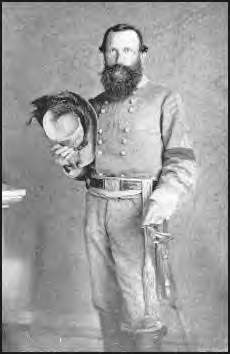
JEB Stuart
J.E.B. Stuart
We needn’t go back 2,000 years, though, to find models of heroism. Let me tell you about two men, in many ways as different as you can find. One was a 19th century soldier, a gallant cavalier who brings to mind the knights errant of long ago. The other was a 20thcentury poet, a visionary heavy with the future. One met an honorable opponent on the field in battle, weapon in hand and his comrades around him. The other struggled with an enemy who dealt in deceit and a stab in the back. He fought his fight alone in military prisons and insane asylums. What they had in common was an unconquerable will, a fire in the gut that makes a man determined to die rather than admit defeat.
The one, J.E.B. Stuart, General of Cavalry, Army of Northern Virginia, Confederate States of America. The other, Ezra Pound, poet, economist, eccentric, and philosopher extraordinaire.
J.E.B. “Jeb” Stuart grew up on a modest plantation in southwestern Virginia. He went to West Point and was commissioned second lieutenant in the U.S. Army and was sent out west to fight Indians. A bullet from a Cheyenne brave almost ended his career before it began, but he survived to serve in Bloody Kansas where he tried, mostly without success, to keep abolitionists and slave owners from killing one another.
When Virginia seceded on April 17th, 1861, Stuart quit the army and went home. He was soon a lieutenant colonel in the Confederate Army. But allow me to introduce him to you as he would have appeared in June of 1863, if you had attended the great cavalry review he held at his headquarters in Culpeper County, Virginia.
It was a hopeful time for the Confederacy. Chancellorsville had been a great victory and defeat at Gettysburg was in the future. New recruits were pouring in, bringing fresh horses with them. (You brought your own horse when you joined the Confederate cavalry.) For a change there was plenty to eat, for men and beasts both.
If you had been on one of the special trains from Richmond, or perhaps driven over in one of the hundreds of carriages which lined the parade ground, you would have been treated to a magnificent show: Lines of troopers two miles long passed in review, their officers clad in splendid new uniforms, sabers glittering in the Virginia sunshine. They staged ferocious charges while the artillery blasted away with blanks.
And, best of all, you would have seen General Stuart mounted on a big blood bay Virginia thoroughbred. He rode over the parade ground, bellowing commands from behind his flowing red beard in a voice which, had everyone been so equipped, would have rendered the microphone a redundant invention.
At about 5’10” and 175 pounds, he was long-limbed and short-bodied and looked best on a horse. And could he ride! One soldier said “He’s the prettiest and most graceful rider I ever saw. I could not help but notice with what natural ease and comely grace he sat on his steed as it bounded over the field.” No soldier ever dressed for the role with more panache. His saddle and bridle were all polished leather and sparkling metal. He wore a gray shell cavalry jacket positively ablaze with gold braid and buttons, and a grey cavalry cape lined with scarlet. Gleaming Russian leather jackboots climbed past his knees and his spurs were of gold. The hands that held the reins were encased in huge yellow leather gauntlets and around his waist was a yellow cavalry sack with golden tassels. His campaign hat was looped up on one side with a gold star and crowned with a black ostrich plume. His sidearms were a big nine-chambered LeMat revolver and a French cavalry saber.
It said that the function of cavalry in war is to add tone to what might otherwise become an unseemly brawl. Jeb Stuart was the living embodiment of that tradition. While they did love military display, there was more to it. Stuart knew that the Confederacy was outmanned, outgunned, and out-produced. Brute force was on the other side. He said, “We must substitute esprit for numbers. Therefore I strive to inculcate in my men the spirit of the chase.” In other words, the preponderance of force was too serious to treat seriously. Better to crack a joke and ride off to the fight, whistling a merry tune, plume waving in the wind. And that’s how Stuart fought his war. One officer said, “Like some chevalier of olden days he rode to battle with his lady’s glove upon his helm, determined to conquer or die.” He lived to the tune of a popular song of the day called, “Join the Cavalry”: If you want to see the Devil, if you want to smell Hell, if you want to have fun, join the cavalry!
And he surrounded himself with his kind of soldier. Sam Sweeny, a former blackface minstrel whose brother reportedly invented the banjo, went with him everywhere, playing Will Scarlet to Stuart’s Robin Hood. General A.P. Hill pleaded: “Keep him away, keep him away from my camp! Every time Jeb Stuart comes around with Sweeny and his banjo he makes my whole division want to join the cavalry.”
Stuart’s chaplain was Major Dabney Ball, known as The Foraging Parson. It was said that no chicken could live in the vicinity of this consummate master of the midnight commissary.
Stuart’s horse artillery was commanded by young John Pelham, son of an Alabama country doctor. At West Point he had amazed the Prince of Wales with his horsemanship. In a dozen battles his reckless courage earned him immortality as The Gallant Pelham. Blond and strikingly handsome in his boyish way, he was like a young Baldur or Siegfried. When he was killed it was said that the train carrying him home was stopped at every station in Alabama by crowds of women who piled his casket high with flowers.
Heros von Borcke
Heros von Borcke
Then there was Heros von Borcke, late of the Third Dragoon Guards, Royal Prussian Army — a gentleman adventurer who ran the blockade to fight for the Confederacy. At 6’4” and 250 pounds, he was described as “a giant in stature, blond and virile with great curly mustaches and the expression in his wide-open blue eyes of a singularly modest boy.” Wielding the largest saber in the Confederate cavalry, von Borcke was the kind of man who could, with some satisfaction, practically decapitate an opponent in battle and that evening squire a pretty girl around the dance floor with all the courtliness of the continental gentleman which he in fact was. Immensely popular, he was the cause of widespread dismay when a rumor somehow spread that he’d been killed in battle. When the governor of Virginia wrote to Stuart, suggesting that the body be sent to Richmond for burial with honors, Stuart wrote back: “Can’t spare body of von Borcke; it is in pursuit of Yankees.”
Robert E. Lee’s sons, Fitz and Rooney, served with Stuart, and what more need be said of them but that they were a credit to the old man.
Stuart’s troopers were, for the most part, born to the saddle and supplied their own horses, many of them thoroughbreds from the stud farms of Virginia and South Carolina. Until attrition wore them down late in the war, both men and mounts were vastly superior to their Union counterparts, many of them city boys riding nags purchased from less than scrupulous dealers. If the horse had more than three legs and wasn’t stone blind it was considered acceptable.
Fine horsemen that they were, Stuart had to teach his men how to soldier. Given the situation, it had to be on-the-job training. One such exercise began with a ride into hostile territory. When they encountered a skirmish line of bluecoats, Stuart rode in their direction and gave the order to dismount. Only when the Union troops were practically on top of them did he allow his men to mount up. As bullets whistled around them, they gracefully rode away — slowly. As though he were lecturing a classroom, Stuart patiently explained: “Cavalry can trot away from anything — and a gallop is a gait unbecoming to a soldier unless he is going toward the enemy. Remember that. We gallop toward the enemy and trot away, always.”
They learned quickly in this hard school. The lessons were taught in little cavalry fights that killed men as dead as Gettysburg. Soon they thought nothing of spending a week in the saddle, and if nothing better came their way they could live off ripe corn, or half ripe corn, eaten raw in some farmer’s field.
Sometimes something better did come their way. In June of 1862, Stuart led 1,200 picked men in a reconnaissance in force around the Union right flank. Scattering the Federal cavalry that got in their way, they burned bridges, shot up trains, cut telegraph poles, and became one of the few cavalry outfits to fight an artillery duel with a warship, specifically the gunboat USS Marblehead. They burned a Federal camp, much to the delight of von Borcke: “The whole camp was enveloped in one blaze, hundreds of tents burning together, wonderfully beautiful.” The ordinary horse solider was more appreciative of the goodies with which the Union army appeared to be supplied in an infinite amount and variety. Stopping to rest the horses, they pigged out on whatever they could find: figs, ketchup, sausages, lemons, oysters — and booze. John Mosby recalled the scene as “a carnival of fun I could never forget. Nobody thought of danger or sleep when champagne bottles were popping.” All had perfect confidence in their leader. When they rode off again, more than a few troopers were three sheets to the wind. Rooney Lee, alarmed, started a rumor that a man had died from drinking poisoned whiskey. As the rumor spread, captured whiskey bottles could be seen arcing through the night air all along the length of the column.
This was the famous Ride around McClellan. Stuart’s army had circumnavigated the entire Army of the Potomac. To add insult to injury, Stuart did it again that fall. Shortly thereafter, McClellan was replaced by Ambrose Burnside, prompting General Lee to remark wistfully, “McClellan and I always understood each other so well and I’m afraid they may keep making these changes until they find someone I don’t understand.”
Stuart never let up. General Joe Johnston said of him, “Stuart is like a yellow jacket. You brush him off and he flies right back on.” On Christmas day, 1862, a raid on Union supply lines resulted in one of the best jokes of the war. At Burke’s Station, Stuart commandeered the local telegraph office and sent the following telegram: “Quartermaster General Meigs, United States Army: Quality of mules furnished me lately very poor. Interferes seriously with movement of captured wagons. Signed:  J.E.B. Stuart.”
Eluding pursuing Yankees proved easier than escaping the admiring southern womenfolk. Stuart was liable to be taken prisoner at any time and his tailor was kept busy replacing buttons lost to the more daring souvenir hunters. Von Borcke recalled an incident in which Stuart was captured by an admiring throng of ladies. “Many,” said von Borcke, “with tears in their eyes, kissing the skirt of his uniform coat or the glove upon his hand.” Stuart demurred, allowing as how a kiss on the cheek might be more appropriate. Von Borcke wrote, “The kisses now popped in rapid succession like musketry, until our general was placed under as hot a fire as I’d ever seen him sustain on the field of battle.”
Stuart’s blue eyes often sparkled with laughter, but they could just as readily flare with fighting fury. “We must nerve our hearts,” he said, “with a determination to die rather than submit.” And death was never far away. Always leading from the front, the famous black plume waving, singing gaily over the din of battle, he had an electrifying effect on his men. But they feared for him. Horses were shot from under him more than once, and on one occasion, to his great amusement, one side of his mustache was shot away as cleanly as if by a barber’s razor. As an admirer wrote, “His indifference to danger impressed everyone. It would be difficult to imagine a coolness more supreme.”
Taking command of the wounded Jackson’s corps at Chancellorsville, Stuart was a subject of ecstatic reports. We see him on his big bay charger, dashing into a crumbling formation, grabbing the battle flag and turning the men around and leading them in the assault, singing, as he always did in battle, his great voice booming over the cannon’s roar. E.P. Alexander said, “I do not think there was a more brilliant thing done in the war. Stuart never seemed to doubt he could crash his way wherever he chose to strike.”
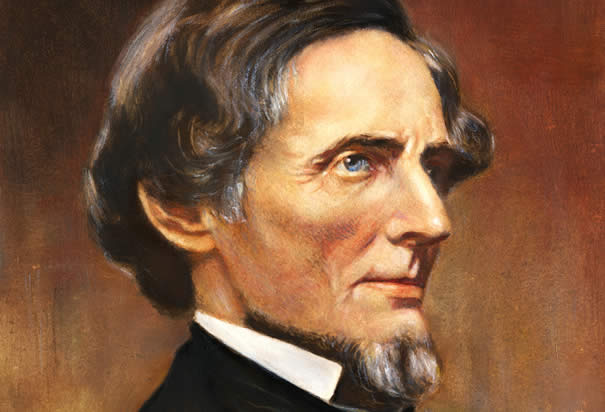
Jefferson Davis, President of the Confederate States of America
Stuart never expected to live through the war, and, in any case, preferred death to defeat: “I’d rather die than be whipped.” It happened on May 11th, 1864, at a place called Yellow Tavern. Stuart sustained a serious abdominal wound, which, considering the limited medical knowledge of the day, gave every indication of being mortal. He was taken to Richmond and the doctors did for him what little they could. When President Jefferson Davis came to ask how he felt, Stuart answered, “Easy, but willing to die if God and my country think I have fulfilled my destiny and done my duty.”
He died at 7:38 PM, May 12th, 1864, and was buried the next day to the roar of distant guns. He was 31 years old. Richmond wept, but there was rejoicing in Valhalla as a mighty warrior strode across the rainbow bridge and entered the great hall of the gods.
* * *
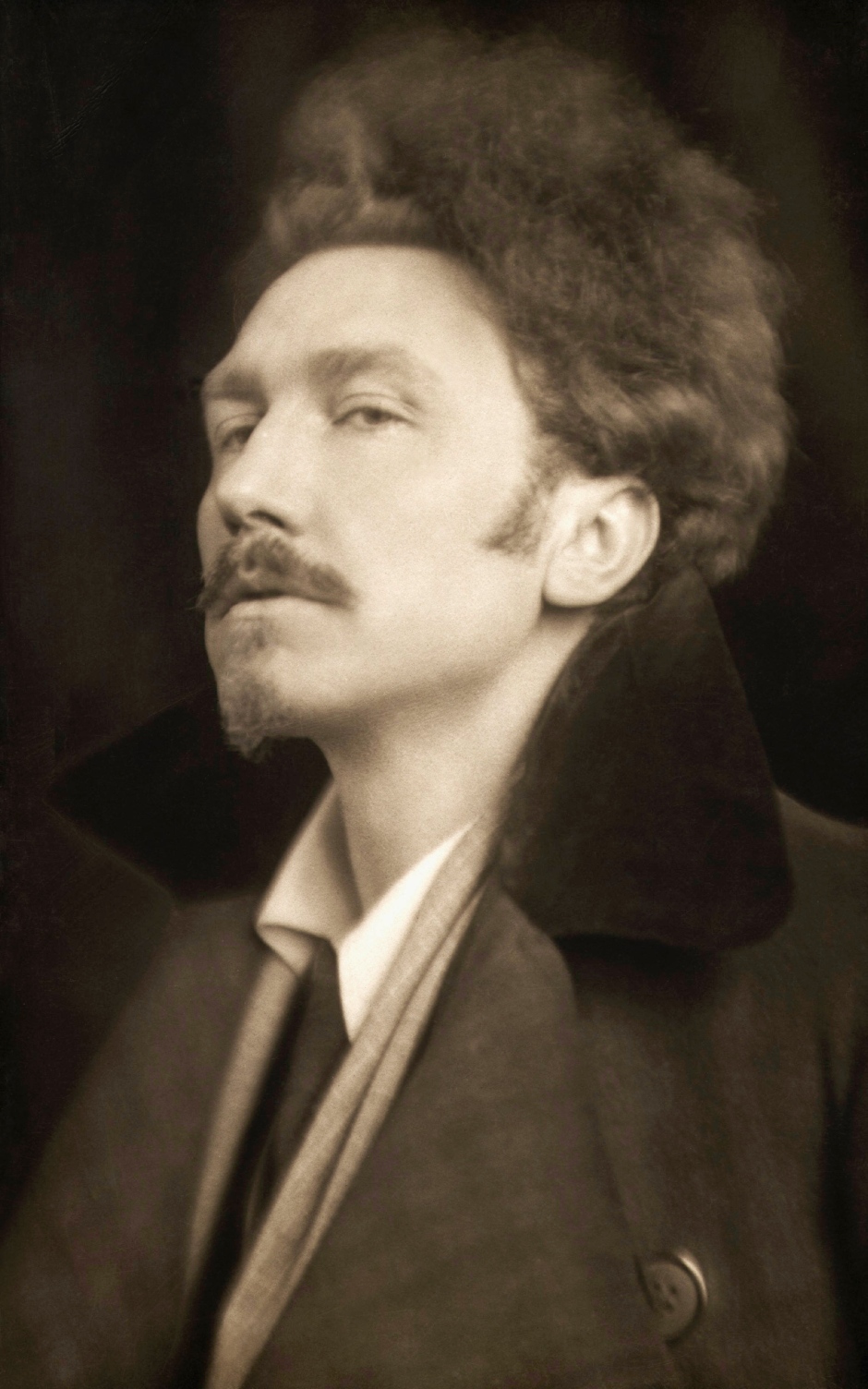
The young Ezra Pound
To me, Jeb Stuart was the quintessential Aryan warrior, the incarnation of the soldierly virtues which will be indispensable to any successful White renaissance. But martial ardor alone won’t save us. The power of the pen must complement that of the sword. We need philosophers as well as soldiers, poets as well as warriors: thinkers like Ezra Pound as well as fighters like Jeb Stuart.
Ezra Pound was the possessor of a penetrating intellect, a man of wide learning, and a gifted lyrical genius. He was a profoundly serious man who never made the mistake of taking himself too seriously. He was a rake, a rogue, a bohemian bon vivant, in short an American original by any standard, an extraordinary individual.
Born in 1885 in Hailey, Territory of Idaho, Pound was raised in Wyncote, Pennsylvania, a suburb of Philadelphia. His father was the assistant assayer at the Philadelphia Mint. His family was wealthy enough that he made two childhood visits to Europe, once with an aunt, and once with his father. After taking his M.A. from the University of Pennsylvania 1905, he went a third time on a research fellowship and spent most of the seven months vagabonding through Provence, Spain, and northern Italy. Brilliant, but brittle, Pound clashed with his professors and his fellowship was discontinued. A short teaching stint at Indiana’s Wabash College ended when a burlesque dancer turned up in his rooms.
He decided to go back to Europe to seek fame and fortune as a poet. Pound arrived in Europe in the spring of 1908 with a sheaf of poems and $80. He lived in Venice that summer in an apartment over a bakery. He strolled along the seashore, lived on sweet potatoes and barley soup, observed the life around him, thought, and wrote poetry. It was as if he was gathering his energies.
In September of that year, Pound collided with London and England trembled from the impact. His energy, wit, and enthusiasm captivated everyone. As William Carlos Williams phrased it, “He lived the poet as few of us had the nerve to live that exalted role in our time.” He was a total nonconformist complete with a broad-brimmed troubadour hat and an earring. At a literary breakfast he astonished his companions by eating a rose from the centerpiece. Then he ate another one.
In six months, Pound had met Williams, D.H. Lawrence, Ford Madox Ford, and William Butler Yeats among others. Within a year he was a published poet of note and a fixture on the literary scene. The next decade was a period of feverish literary activity; ten years during which Pound practically invented modern poetry and profoundly influenced, discovered, or promoted such luminaries as T.S. Elliot, Robert Frost, and James Joyce.
He was a key figure in a movement which he called Vorticism, a rebellion against Victorian rigidity which had some elements in common with the Italian Futurists. He said, “We might come to believe that the thing that matters in art is a sort of energy, something more or less like electricity; transfusing, welding, and unifying.”
After the Great War of 1914-18 Pound became convinced that something was terribly wrong with Western civilization, and he determined to find out what it was. It was at this time that he met Major Clifford Hugh Douglas, a civil engineer who had worked out a new economic philosophy called Social Credit. In brief, it was based on the idea that wars and economic disruptions are caused by the manipulations of a small group of international financiers. To Pound and others, it soon became apparent that most of these people were Jews. Indeed the whole usurious modern economic system was a gargantuan Semitic swindle, a con game on a colossal scale.
This was Pound’s personal Rubicon, and he crossed it without a backward glance. He wrote a poem on the subject:
With usura hath no man a house of good stone
each block cut smooth and well fitting…
no picture is made to endure nor to live with
but it is made to sell and sell quickly
with usura, sin against nature,
is thy bread ever more of stale rags
is thy bread dry as paper,
with no mountain wheat, no strong flour…
Usura rusteth the chisel
It rusteth the craft and the craftsman…
Usura slayeth the child in the womb
It stayeth the young man’s courting
It hath brought palsey to bed, lyeth
between the young bride and her bridegroom
              CONTRA NATURAM
They have brought whores for Eleusis
Corpses are set to banquet
at behest of usura.
By 1921, Pound had found London becoming stale and he went to Paris. He met anybody who was anybody in the “lost generation.” Gertrude Stein didn’t find him amusing, but to Ernest Hemingway “He was the man I liked and trusted the most as a critic.” After a three-year sojourn in the City of Light, Pound decided to avail himself at the more peaceful, if less brilliant, surroundings of Rapallo, a picture-postcard Italian resort town not far from Genoa. Red tile houses climbed up the hills from the Mediterranean, and from his apartment he could observe the interplay of light and color on the sea. As he wrote to a friend, “I knew paradise when I saw it.”
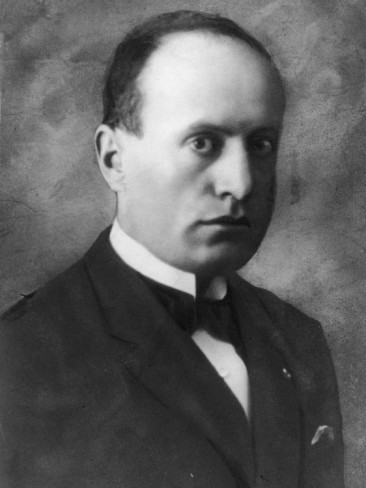
Italian leader Benito Mussolini
Benito Mussolini was building a new Italy and Pound took an interest in Fascism. He thought he detected a kindred spirit in the Duce. He saw Mussolini, whom he referred to as The Boss, as a man driven by a vast and deep concern, or will, for the welfare of Italy. Not Italy as a bureaucracy, or Italy as a state machinery stuck up on top of the people — but for Italy organic, composed of the last plowman and the last girl in the olive yards. From his headquarters in Rapallo poured forth a steady stream of correspondence, books, articles, and poems chiefly concerning politics and economics. “Quite simply,” he wrote, “I want a new civilization.”
Unimpressed by the irrelevancies pursued so avidly by his former literary colleagues, he declared “Preserving public morality is more important than exploring psychological hinterlands.” As Jew-inspired war fever began building in the 1930s, Pound leapt to the defense of Italy against the Judocratic press. And not only Italy: When he became the object of propaganda on behalf of the Spanish Communists, he fired off a counter-blast, calling the anti-Franco crusade “an emotional luxury to a gang of sap-headed dilettantes.” In What Is Money For he commended the author of Mein Kampf for his statement that “the struggle against international finance and loan capital had become the most important point in the National Socialist program; the struggle of the German nation for its independence and freedom.”
In the spring of 1939, Pound sailed to the U.S. in a last ditch bid to sidetrack the Hebrew war machine. He talked to a number of isolationist politicians in Washington, but he really didn’t get anywhere. Elsewhere, though, he got his licks in. During a poetry reading at Harvard, he noticed that quite a few Jews were in the audience — and promptly changed the program to include his most “anti-Semitic” poems.
When war came, Pound was back in Rapallo and there he stayed. Convinced that his duty to his country lay in exposing the treasonous machinations of Roosevelt and his Jew bosses, he offered his talents to the Italian broadcasting service. His American Hour broadcasts crackled across the airwaves, propelled by a righteous fury at the treason, ignorance, and stupidity that was leading the Anglo-Saxon powers down the garden path: “Democracy,” he said, “is now defined in Europe as a country governed by Jews.” The chief villain was variously labeled “Franklin Finkelstein Roosevelt,” “Stinky Roosenstein,” or “Jewsfelt.” Whatever his name was, Pound considered him “below the biological level at which the concept of honor enters the mind.” The first lady became “Eleanor Oozenfeld”; a personage, according to Pound, “who has carried vulgarity to the point of obscenity and has the mind of a lavatory attendant.”
He spoke to both England and America: “Europe calling, Pound speaking. They say an Englishman’s head is made of wood, and an American’s head is made of watermelon — it’s easier to get something into the American’s head, but well nigh impossible to make it stick for ten seconds. I don’t know what good I’m doing — I mean what immediate good — but some things you folks on both sides of the wretched ocean will have to learn, war or no war, sooner or later.”
Pound told them the facts of life in no uncertain terms: “Ezra Pound speaking from Rome. Is there a race left in England? Has it any will to survive? I doubt it. Nothing can save you, save a purge; nothing can save you save the affirmation that you are English. Hore Belisha is not. Isaacs is not. No Sassoon is an Englishman racially. No Rothschild is English, no Baruch, Morgenthau, Cohen, Lehmann, Warburg, Kuhn, Schiff, Sieff, or Solomon was ever yet born Anglo-Saxon. And it is for this filth that you fight. It is for this filth that you have murdered your empire.”
The perversity of American policy aroused both Pound’s anger and his pity: “For the United States to be making war on Italy is just plain damn nonsense. There’s no connection between submitting to the Roosevelt/Morgenthau frauds and patriotism. There’s no patriotism in submitting to the prolonged multiple frauds of the Roosevelt administration. And to try to make the present support of these frauds figure as loyalty to the American heritage is so much dirt and buncombe. There’s so much that the United States does not know. This war is proof of such vast incomprehension, such tangled ignorance — so many strains of unknowing. You are in black darkness and confusion. You have been hugger-muggered and scarum-shouted into a war and you know nothing about it. You know nothing about the forces that caused it.” Like a beacon of sanity shining through a fog of madness, Pound berated, cajoled, and scolded his countrymen, who in their confusion sent their sons to die for a gang of cutthroats and shysters.
Despite the herculean efforts of the warriors of the New Order, an inscrutable fate gave the victory to the bigger battalions of the befuddled Allies, and on April 28th, 1945, Mussolini and his mistress, Claretta Petacci, were ritually murdered by Communist partisans. By May 3rd American troops were in Rapallo, and the Reds had arrested Pound.
A defiant Ezra Pound, photgraphed immediately after his arrest in 1945
A defiant Ezra Pound, photographed immediately after his arrest in 1945
He was turned over to the counter-intelligence center in Genoa, and a 13-year ordeal began which would have broken the will of many men much younger than Pound’s 60 years. But to his eternal credit he fought for his beliefs, for his sanity, for his very existence. And he wrote poetry.
For three weeks Pound was confined in a 6 foot by 6.5-foot wire cage. Exposed by day to the heat, glare and dust, by night it was brilliantly floodlit. The toilet was a tin can. Pound shadowboxed, played tennis, fenced with imaginary opponents, watched the insect life, and tried to survive. His spirit resisted but flesh wilted under that brutal regimen. His memory failed and he collapsed. Only then, half dead, was he put in a tent, which, while far from comfortable, was less murderous than what he called “the gorilla cage.”
After six months of detention without trial, Pound was flown to Washington, D.C., declared mentally incompetent, and confined in the ward for the criminally insane at St. Elizabeth’s Hospital. A grim human warehouse built in the 1880s, it would be Pound’s home for 13 months. His cell had a black steel door with nine peepholes — to allow observation of the lunatic within. Madmen shambled up and down the hall outside, drooling and gibbering. Visitors recoiled at the overpowering odors of sweat and bile. But it was the visits to which Pound clung as a sheet anchor of sanity. At night loneliness and claustrophobia closed in. By day, psychiatrists poked and prodded in endless mental examinations.
In spite of everything, Pound kept both his sanity and his integrity. True to himself, he could later say, “I remember a moment of quite irrational happiness in the hellhole.”
In February 1947, Pound was at last moved to a regular ward and allowed visitors for two hours a day. Over the next eleven years he carried on manfully, doing his best to live as a sane man in an insane world. In spite of his imprisonment, his literary reputation continued to grow and pressure for his release mounted.
Finally, in May of 1958, the treason indictment against him was dismissed and the 73-year-old poet was released. He wasted little time in returning to Italy. In Naples, he was photographed giving the Fascist salute and was quoted as saying, “All America is an insane asylum.”
Nietzsche said, “Many live too long, and many a one grows too old even for his truths and victories.” Sadly, this was true of Pound. In his ninth decade, his vitality slowly ebbing, he seemed to lose faith in his poetry and his vision and in himself. What Man couldn’t do was accomplished by Time, which wears down even the mountains.
The essential Pound, though, lives on in his poetry:
“Thank you, whatever comes.” And then she turned
And, as the ray of sun on hanging flowers
Fades when the wind hath lifted them aside,
Went swiftly from me. Nay, whatever comes
One hour was sunlit and the most high gods
May not make boast of any better thing
Than to have watched that hour as it passed.
Ezra Pound, back in Italy and still defiant after 13 years of false imprisonment by the US government: "All America is an insane asylum."
Ezra Pound, back in Italy and still defiant after 13 years of false imprisonment by the US government: “All America is an insane asylum.”
A popular song of a few years ago contained a line that went, “It’s a strange, strange world we live in, Master Jack.” It is indeed a strange world, a world in which Ezra Pound is declared insane while a bag of garbage like Martin Luther King is enshrined as a national hero — a world where the misshapen, the botched, and the retarded are the subject of a morbid fascination, while millions of healthy babies are flushed down the sewers with no more ceremony than is accorded the disposal of a stale bologna sandwich — a world turned upside down, in which all that is worthy and noble is condemned, while the perverse, the wretched, and the downright rotten is held up as the ideal. Living in such a world and keeping one’s sanity, not to mention one’s good humor, is not always an easy task.
But not only must we live and avoid going bananas, we must fight to bring into being a new and better world. As the hero said in The Outlaw Josey Wales, “If things get bad and it looks like you’re not going to make it, you gotta get mean — I mean plumb mad dog mean — ’cause if you lose your head and give up, you neither live nor win. That’s just how it is.”
It’s going to be a long war. At times each of us will feel the clammy fingers of despair clutching at his throat and hear an insistent voice, clamoring, “Give up, it’s no use.” Help one another. When one weakens, another must be strong. In the midst of the wreckage of a dying civilization take your inspiration from your heritage and from each other. Nietzsche said that we should love war. I believe that — for only in struggle can we develop to our maximum potential.
Rejoice, then, for it has been given to us to be soldiers in the greatest war of them all. As Zarathustra said, “I do not exhort you to peace; I exhort you to victory. What good is long life, what warrior wants to be spared? I do not spare you; I love you from the very heart, my brothers in war.” Thank you.
Listen to JEB Stuart and Ezra Pound
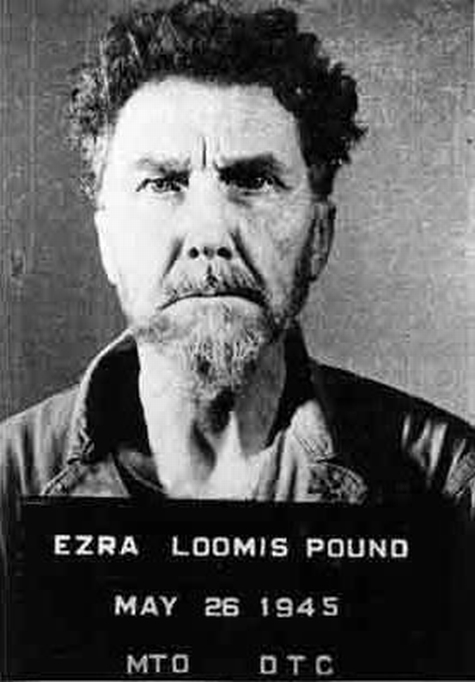
Further Reading

Monday, September 30, 2013

Dr. Pierce on Feminism: The Great Destroyer

Feminism: The Great Destroyer
An Interview with Dr. William Luther Pierce
By Kevin Alfred Strom

K.A.S.: There is a continuing public debate about the role of women in our society and the related subjects of sexism and feminism. One example was the hullabaloo that occurred during the confirmation of Clarence Thomas's appointment to the Supreme Court. Feminists and their claque in the media charged that this confirmation was an affirmation of the "sexism" rampant in the U.S. political establishment. The cure for this alleged problem is to get more women into positions of political power, according to many people in the media.

Another example was the uproar about a drunken party several years ago in Las Vegas for Navy fliers at which several women who showed up were manhandled -- in particular, a female flier who later complained to the media about her treatment. The news coverage of the Las Vegas party brought demands from media spokesmen and politicians for rooting out the "sexism" in the armed forces and giving women equal roles in everything from infantry combat to flying fighter jets. Do you see any real or lasting significance in this debate?


W.L.P.: Oh, it's certainly a significant debate. The significance is perhaps not exactly what the media spokesmen would have us believe it is, but there is a significance there nevertheless. Getting at the real significance, pulling it out into the light where everyone can see it and examine it, requires a little care, though. There's a lot of misdirection, a lot of deliberate deception in the debate.

Look at the first example you just mentioned. The controlled media would have us believe that the approval of Clarence Thomas by the Senate Judiciary Committee in the face of Anita Hill's complaints about him demonstrates a callous insensitivity to women's welfare. But what were Anita Hill's complaints? They were that when Thomas had been her boss in the Equal Employment Opportunity Commission he had asked her several times for a date and that on one occasion he had begun describing to her a pornographic film he had seen the evening before. She never alleged that he had demanded sexual favors from her, threatened her, or put his hands on her. Her complaint was that he had shown a normal, healthy interest in her as a woman. He had asked her for a date.

Talking to her about a pornographic film may have indicated a certain lack of refinement on his part -- at least that would be the case if the two of them were members of a traditional White society, in which gentlemen didn't talk about pornographic films in the presence of ladies, at least not in the office -- but what the hell, the folks who were raising such a fuss about Thomas's behavior are, like both Clarence and Anita themselves, all members of the brave, New World Order society, which is neither White nor traditional. It's a so-called "multicultural" society in which there are no gentlemen and there are no ladies; there are just male and female people, and the female people are no different from the male people: they are just as bawdy, just as vulgar, just as aggressive.

K.A.S.: So you believe that the whole thing was just a tempest in a teapot, that it really wasn't significant?

W.L.P.: A tempest in a teapot, yes, but still very significant. One aspect of the Clarence and Anita circus was that it was simply seized on and used by people with a certain political agenda, and so of course their tendency was to make as much ado as they could about it. But another aspect is that many of the feminists who were screeching against Thomas and against the Senate's approval of him really were indignant that the man had asked Anita Hill for a date. They really were outraged that he had an interest in her as a woman and did not simply treat her as another lawyer in his office. Men are not supposed to notice women as women, but only as people, and radical feminists really do become angry if one drops this unisex pretense even for a minute. Open a door for one of them and you'll get a nasty glare; call one of them "my dear" or refer to her as a "girl" and you'll be slapped with a civil rights lawsuit.

The fuss about this Tailhook Association party in Las Vegas reveals the same sort of nuttiness. I mean, what do you expect when a bunch of Navy fliers throw a wild, drunken orgy? They had held their party in Las Vegas several years in a row, and the party had gained a bit of a reputation. It was notorious. Everybody in Naval aviation knew all about it. The Navy women who went to the party knew what to expect. They joined the orgy. Any woman who didn't want to be pawed by drunken fliers and have her panties pulled off stayed away. Certainly, if these Navy fliers had shanghaied some unsuspecting woman off the street and forced her to submit to indignities, I would be the first to call for their being put up against a wall. I'll go further and say that I really don't approve of drunkenness under any circumstances -- although I believe it's only realistic to accept drinking as a fact of military life. But I cannot work up much sympathy for a woman who, knowing what the Tailhook parties are like, decides that she will pretend that she really isn't a woman but rather is a genderless Navy flier and so can go to the Tailhook party without worrying about her panties.

K.A.S.: That's really irrational isn't it? It doesn't make sense to ignore human nature like that.

W.L.P.: Irrationality seems to be the rule rather than the exception in public affairs these days. Feminism, of course, is just another exercise in reality denial, which has become such a common pastime. There are too many people out there who seem to believe that if we pretend that men and women are the same, they really will be; that if we pretend there are no differences between Blacks and Whites except skin color, the differences will disappear; that if we pretend that homosexuality is a normal, healthy condition, it will be.

Feminism is one of the most destructive aberrations being pushed by the media today, because it has an immediate effect on nearly all of us. There are many sectors of the economy, for example, in which racial-quota hiring and promotion - so-called "affirmative action" -- isn't a real problem, and so White people who work in those sectors remain relatively unaffected by the racial aspects of America's breakdown, but feminism is becoming pervasive; there are few relationships between men and women, especially between younger men and women, which will not suffer from the effects of feminism in the near future.

K.A.S.: You just referred to feminism as "a destructive aberration" and spoke of the breakdown of America. Are the two things connected?

W.L.P.: When homosexuals come out of the closet and women go into politics, empires crumble. Or, to say that a way which more accurately reflects the cause-effect relationship, when empires begin to crumble, then the queers come out of the closet and women go into politics. Which is to say, that in a strong, healthy society, feminism isn't a problem. But when a society begins to decay -- when the men lose their self-confidence -- then feminism raises its head and accelerates the process of decay.

K.A.S.: Before we go further, exactly what do you mean by feminism? Can you define the word for us?

W.L.P.: Feminism is a system of ideas with several distinguishing characteristics. First, it's a system in which gender is regarded as the primary identifying characteristic, more important even than race. Second, and paradoxically, it's a system in which men and women are regarded as innately identical in all intellectual and psychical traits, and in all physical traits except those most obviously dependent on the configuration of the genitalia. Third, it's a system in which filling a traditionally male role in society is valued above being a wife and mother, a system in which the traditional female roles are denigrated. Finally, it's a system in which men and women are regarded as mutually hostile classes, with men traditionally in the role of oppressors of women; and in which it is regarded as every woman's primary duty to support the interests of her fellow women of all races against the male oppressors.

I should add that not every woman who describes herself as a feminist would go along 100% with that definition. Real feminism is not just an intellectual thing; it's a sickness, with deep emotional roots. Some women just want to be trendy, but are otherwise normal. They just want to be fashionable, and feminism is held up by the media as fashionable these days. It's Politically Correct.

And while we're at it, we should note that there is an analogous malady, usually called male chauvinism, which expresses itself in a range of attitudes toward women ranging from patronizing contempt to outright hatred. Feminists often attribute the growth of feminism to a reaction against male chauvinism. Actually the latter, which never afflicted more than a minority of White men, has been more an excuse for the promoters of feminism than a cause of that disorder.

K.A.S.: OK. So that's what feminism is. Now, in what way is it destructive? How is it connected to America's decline?

W.L.P.: Feminism is destructive at several different levels. At the racial level it is destructive because it divides the race against itself, robbing us of racial solidarity and weakening us in the struggle for racial survival; and because it reduces the White birthrate, especially among educated women. It also undermines the family by taking women out of the home and leaving the raising of children to television and day-care centers.

At a personal or social level feminism does its damage by eroding the traditional relationship between men and women. That traditional relationship is not based on any assumption of equality or sameness. It's not a symmetrical relationship, but rather a complementary one. It's based on a sexual division of labor, with fundamentally different roles for men and women: men are the providers and the protectors, and women are the nurturers. Men bring home the bacon, and they guard the den; women nourish the children and tend the hearth.

Many people today sneer at this traditional relationship. They think that in the New World Order there is no need to protect the den or the condo or whatever, because these days we're all very civilized, and that all one needs to do to bring home the bacon is hop in the car and drive to the nearest shopping mall, and, of course, a woman can do that just as well as a man. Therefore, because the times have changed, roles should change. There's no longer any reason for a division of labor; now we can all be the same, claim the apologists for feminism.

Now, I have a couple of problems with that line of reasoning. First, I'm not as eager to toss million-year-old traditions in the ash-can as the New World Order enthusiasts are, because I'm not as confident in the ability of the government to provide protection for all of us as they are, nor am I as confident that there'll always be bacon at the neighborhood shopping mall and we won't have to revert to earlier ways of getting it. Actually, I'm an optimist by nature, but I'm not so optimistic as to believe that I'll never be called on to use my strength or my fighting instincts to protect my family. In fact, every time I watch the evening news on television, I become more convinced that there's a very good chance we're going to end up having to fight for our bacon within the next few years.

In the second place, Mother Nature made a very big investment in her way of doing things over the past few million years of primate evolution. It's not simply a matter of our deciding that we don't like Mother Nature's plan because it's not fashionable any longer, and so we'll change it. We are what we are. That is, we are what millions of years of evolution have made us. A man is a man in every cell of his body and his brain, not just in his genitalia, and a woman is a woman to the same degree. We were very thoroughly and precisely adapted to our different roles. We can't change reality by passing a civil rights law. When we deceive ourselves into thinking that we can, there's hell to pay. Which is to say that we end up with a lot of very confused, disappointed, and unhappy men and women. We also end up with a lot of very angry men and women, which accounts for the feminists and the male chauvinists.

It's true, of course, that some women might be perfectly happy as corporate raiders or professional knife fighters, just as some men have willingly adapted to the New World Order by becoming less aggressive and more "sensitive." But it doesn't work that way for normal men and women. What the normal man really wants and needs is not just a business partner and roommate of the opposite sex, but a real woman whom he can protect and provide for. And what a normal woman really wants and needs with every fiber of her being, regardless of how much feminist propaganda she's soaked up, is a real man, who can love and protect her and provide for her and their children. If she's watched too much television and has let herself be persuaded that what she wants instead of a strong, masculine man is a sensitive wimp who'll let her wear the trousers in the family half the time, she's headed for a severe collision with the reality of her own nature. She'll end up making herself very neurotic, driving a few men into male chauvinism, and becoming a social liability. Our society just can't afford any more of that sort of foolishness. If feminism were only making individuals unhappy, I wouldn't be very concerned about it. I've always believed that people were entitled to make themselves as unhappy as they wanted to. But unfortunately, it's wrecking our society and weakening our race, and we must put a stop to it soon.

K.A.S.: How do you propose to do that? The feminist movement really seems to be snowballing, and as you noted the mass media are all for it. It would seem pretty difficult to stop. Anyone who opposes the feminists is perceived as a male chauvinist who wants to take away women's rights and confine them to the kitchen and the bedroom.

W.L.P.: Well, of course, I'm not in favor of taking anything away from women. I'd like to give women the option of being women again in the traditional way, in Nature's way, the option of staying home and taking care of their children and making a home for their husbands. It wasn't the feminists, of course, who changed our economy so that it's no longer possible for many families to survive unless both the man and the woman are employed outside the home. A society which forces women out of the home and into offices and factories is not a healthy society. I'd like for our society to be changed so that it's possible once again for mothers to stay at home with their children, the way they did back before the Second World War, back before the New World Order boys got their hands on our economy and launched their plan to bring the living standard of the average American wage earner down to the average Mexican level. I think many will want to stay home when it's possible to do so. And I am sure that if we provide the right role models for women, most will want to. If we regain control of our television industry, of our news and entertainment and advertising industries, we can hold up quite a different model of the ideal woman from the one being held up today.

Most women, just like most men, want to be fashionable. They try to do and be what's expected of them. We just need to move that model back closer to what Mother Nature had in mind. Then there's no need to take away anybody's rights. A few female lawyers with butch haircuts can easily be tolerated in a healthy society -- a few flagpole sitters, a few glass eaters, a few of all sorts of people -- so long as their particular brand of oddness doesn't begin undermining the health of the whole society.

K.A.S.: But what about the people who control the media now -- what about the legislators -- who are on the feminist bandwagon? They are very powerful. What will you do about them?

W.L.P.: We'll do whatever is necessary. Now we're helping people understand feminism and the other ills which are afflicting our society. Understanding really must come first. After understanding comes organization. And then, as I said, whatever is necessary.

And I should add this: Whatever flies in the face of reality is inherently self-destructive. But we cannot wait for this disease to burn itself out. The toll will be too great. We have to stand up against it and oppose it now. We have to change people's attitudes about feminism being fashionable. We have to make the politicians who've jumped on the feminist bandwagon understand that there will be a heavy price to pay, some day, for their irresponsibility.

K.A.S.: Do you really think that you can change the behavior of the politicians?

W.L.P.: Perhaps not, but we must at least give them a chance to change. Unfortunately in the case of the politicians most of them have many crimes besides an advocacy of feminism to answer for, and they know that they can only be hanged once. 

Sunday, September 22, 2013

Dr. Pierce reads Kipling

The Stranger, recited by Dr. William L. Pierce


The Stranger
by  Rudyard Kipling

The Stranger within my gate,
  He may be true or kind,
But he does not talk my talk--
  I cannot feel his mind.
I see the face and the eyes and the mouth,
  But not the soul behind.

The men of my own stock,
   They may do ill or well,
But they tell the lies I am wanted to,
   They are used to the lies I tell;
And we do not need interpreters
   When we go to buy or sell.
   
The Stranger within my gates,
  He may be evil or good,
But I cannot tell what powers control--
  What reasons sway his mood;
Nor when the Gods of his far-off land
   Shall repossess his blood.

The men of my own stock,
   Bitter bad they may be,
But, at least, they hear the things I hear,
  And see the things I see;
And whatever I think of them and their likes
   They think of the likes of me.

This was my father's belief
  And this is also mine:
Let the corn be all one sheaf--
  And the grapes be all one vine,
Ere our children's teeth are set on edge
  By bitter bread and wine.

Saturday, August 10, 2013

Book review: An American's Dissident Voice

A book review by Andrew Hamilton, April, 2013

An American Dissident’s Voice
American Dissident Voices cover
William L. Pierce
American Dissident Voices
Ed. Shane Webster
Melbourne, Australia: Politically Incorrect Press, 2011

This is a 1,666 page PDF file containing 290 transcribed American Dissident Voices (ADV) radio broadcasts—essentially spoken essays—by William L. Pierce (1933–2002), beginning with his seminal speech “Our Cause,” recorded in 1976, and ending with “Mossad and the Jewish Problem” (June 29, 2002). Its virtue is that it conveniently collects 290 essays into a single file. Previously, it was only possible to access these works piecemeal.

I downloaded the file a few days ago after finding it on a Christian Identity website. Unfortunately, the site is now offline. American Dissident Voices is also supposedly available at Scribd, which I find not a tremendously useful resource, but the page containing the title froze and would not load when I tried to access it. The point is, there is an electronic collection of Pierce’s ADV broadcasts floating around out there.

At present, audio versions of many Pierce broadcasts are available online. Archive.org contains 308 ADV broadcasts that can be listened to or downloaded, and the website of the National Alliance (NA), the white racialist organization founded by Pierce, also archives many broadcasts.

To access the latter, go to the National Alliance home page, place your cursor over the “American Dissident Voices” tab at the top, and click on “Recent Broadcasts” on the drop-down menu. Select any year up to mid-2002 to listen to individual broadcasts. Over the past year, the National Alliance website has frequently been down [It appears now to be down permanently]

Because pro-white material is so frequently censored or removed from the Internet, and pro-white organizations and websites do not last for long, those interested in listening to programs or saving audio or electronic text files should do so in a timely manner.

It is important to build upon the work of those who went before, rather than losing their arduous contributions to our cause through inattention and neglect, stupidly trying to reinvent the wheel every 10 years. We must know about the works of previous white thinkers and activists not solely through hostile, agenda-driven, racist secondary accounts by Jews, academics, and journalists, but directly from our own people.

William Pierce and American Dissident Voices

A Southerner of English, Irish, and Scotch Irish extraction, William Pierce was a professor of physics who left academia in the mid-1960s to join George Lincoln Rockwell‘s American Nazi Party and edit its ideological journal, National Socialist World.

After Rockwell’s assassination in 1967, Pierce joined the National Youth Alliance, which in 1974 became the National Alliance. He remained head of the National Alliance until his sudden, unexpected death from cancer in 2002. As with Rockwell, Pierce’s death occurred exactly when he began to gain some traction after years of often fruitless effort.

Jewish organizations, secret police agencies, and anti-white racists probably regarded William Pierce as the most serious threat to the System in the three decades prior to his death. He combined a fierce revolutionary mentality and sophisticated critique of the existing order with sustained efforts at building a militant, real-world organization.

Pierce was highly critical of Jews and their role in destroying the white race. It is probably fair to say that he hated Jews almost as much as Jews hate whites.

Pierce was a prolific and disciplined writer. His exceptional intelligence, unsurpassed work ethic, prodigious energy, extensive knowledge, and clarity of expression created a body of work that should be preserved for future generations. Unfortunately, most of it appeared in formats that today are not readily accessible.

Beginning in the 1990s and continuing until his death in 2002, he wrote and broadcast a new American Dissident Voices talk every week. ADV evolved into the major outreach tool of the National Alliance. More Americans probably became aware of William Pierce and the National Alliance through that radio program, and then over the Internet, than by any other means.

According to a biography written by University of Vermont professor Robert S. Griffin, The Fame of a Dead Man’s Deeds: An Up-Close Portrait of White Nationalist William Pierce (2001), ADV was the brainchild of National Alliance member Kevin Alfred Strom, a former broadcast engineer, who founded it in 1991.

American Dissident Voices, Griffin writes, “was Strom’s operation. He negotiated with stations, produced the tapes of the shows in a studio he set up on the second floor of the Alliance’s headquarters building [in rural West Virginia], and mailed the tapes to the radio stations for later broadcast. He also hosted most of the programs—Pierce handled about one a month.” Some programs consisted of interviews with Pierce.

Kevin Strom in 1991 in the first American Dissident Voices radio studio

“Strom published the scripts of the broadcasts in a monthly Alliance newsletter called Free Speech, and sold audio tapes of the programs through National Vanguard Books catalogs.”

The primary means of dissemination in pre-Internet days was via shortwave station WWCR (World Wide Christian Radio) in Nashville, Tennessee, although I recall also listening to the show over a different shortwave transmitter, WRNO in New Orleans. In the US, ADV was heard on some AM and FM stations, too.

This should provide an idea of how innovative some of our white predecessors have been.

Shortwave broadcasts cannot be heard with ordinary radios; a special shortwave receiver is necessary to snag them from the ether. Shortwave broadcasts travel much farther than regular broadcasts. I used to listen to official (government) shortwave news shows from Finland, Norway, and Sweden. Some programs were in English, but Norway broadcast only in Norwegian.

According to biographer Griffin, Pierce took over the task of doing the American Dissident Voices broadcasts full-time in 1997.

Pierce’s weekly ADV essays total 1,666 pages here. This does not include any of his other writings, which were quite extensive. Griffin noted that Pierce was completely averse to recycling programs; he insisted upon producing a new show each week.

Unfortunately, electronic preservation, while preferable to no preservation whatsoever, falls short of the permanent preservation capabilities offered by print. E-texts are more cumbersome to read, whether on a computer or on a dedicated device such as a Kindle.

Moreover, rapid, unending changes in technology tend to cause enormous amounts of stored material to “disappear,” since it is impossible for most people to continuously update and convert their entire backlog to new formats. That is a full-time job in itself.

Years ago I already owned more than 1,200 books. How could I possibly have “updated” them if storage formats changed every three years?

Similarly, I have old family movies still on Super 8 mm film, and others on VHS videocassettes. But I no longer have access to a Super 8 projector or screen. And VHS has been superseded by DVDs (for playing or recording movies) and digital cameras. Now DVDs are themselves becoming obsolete.

Songs were formerly recorded and played on vinyl records, then 8-track tapes (ever heard of those?), audio cassettes, CDs, and are now stored and played in digital format.

If you are thoroughly familiar with William Pierce, American Dissident Voices, and National Vanguard magazine, you may not fully appreciate the difficulty of keeping his work alive and acquainting new people or new generations with it. Yet, a mere ten years after Pierce’s death, many people, even white nationalists, no longer know who he was, or know him only by name. This problem repeats itself across the entire spectrum of white thinkers who made invaluable contributions to our cause over the years.

The virtue of this particular American Dissident Voices PDF is that it collects all or most of Pierce’s ADV essays in one place in a file that is searchable. Previously, the essays were only available piecemeal.

It would have been nice if the editor had included the dates of the original broadcasts, but they were omitted. Also, although I cannot swear to the textual integrity of the contents, they appear to be accurate.

There is a Table of Contents providing the title of each essay and the page where it can be located. Although there is no Index, the Search function takes you directly to any essay, and can find specific words or phrases as well.

The essays might be somewhat dated because of a tendency to play off of current events. For example, during the Clinton Administration Pierce frequently castigated the President—who was, of course, a real turd.

Years ago I read two books from the 1930s collecting famous newspaper columnist Westbrook Pegler’s columns from that time. They had become so outdated as to have almost no relevance. But Pierce typically illustrated or explicated fundamental principles, greatly minimizing this problem. And some essays are not related to current events at all.

Another feature of the ADV essays, each of which was slightly longer than 3,000 words, is that they were all written to fit a half-hour format. Though the ideas and prose are crystal clear, the subject matter is somewhat diffuse, or tends to wander more, than in essays and articles Pierce wrote specifically for print publication. The latter are more tightly constructed.

Conclusion

In a 1997 broadcast Pierce observed,
The process of social atomization, of deracination, of separating people from their roots and cutting the bonds to their natural communities so that they can become interchangeable units—human atoms—for building the New World Order is being promoted ruthlessly by the Jews and their collaborators. This process is genocidal, because it will certainly destroy us as a people, as a race, as well as destroying us as a nation. (“The Nature of Patriotism,” p. 203)

His view of the situation:

We should never think, "Well, I am only one person. What I do or don’t do isn’t important. I can’t make a difference by myself."
 
That kind of thinking is wrong. We can make a difference. Courage is contagious. It spreads from person to person.
 
And it is powerful. One courageous truth-teller can back down a thousand cowards and liars and hypocrites.
 
There has never been a time in the long history of our race when we were more in need of a few honest men and women, a few people of courage and integrity. There has never been another time when a few good men and women had the opportunity to make such a big difference as they can make right now. (“Brainwashing in America,” 1995, pp. 48–49)